2019 · GS Paper 2 · Q12 · 15 marks
Parliament's power to amend the Constitution is a limited power and it cannot be enlarged into absolute power. In the light of this statement explain whether Parliament under Article 368 of the Constitution can destroy the Basic Structure of the Constitution by expanding its amending power.
In short
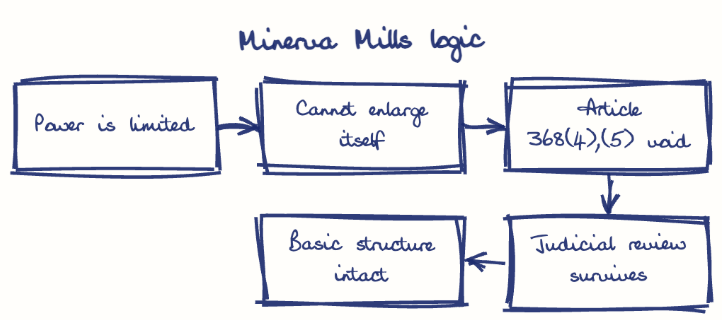
Parliament cannot destroy the basic structure by expanding its amending power, because Article 368 confers only a limited power. Minerva Mills (1980) struck down Article 368(4) and (5), added by the 42nd Amendment, for trying to make that power absolute.
Model answer
Ghissu Editorial · Verified 4 Oct 2026 · 271 words
Answer to Golaknath
The 24th Amendment (1971) added Articles 13(4) and 368(3) so that amendments could reach any part, including Fundamental Rights.
Ousting courts and limits
The 39th Amendment (1975) put the Prime Minister's election beyond courts, and the 42nd Amendment (1976) added Article 368(4) and (5), barring judicial review and claiming unlimited constituent power.
Amend is not destroy
Kesavananda Bharati (1973) upheld the 24th Amendment but held that an amendment must leave the Constitution's identity intact.
Self-enlargement void
Indira Gandhi v. Raj Narain (1975) struck Article 329A(4), and Minerva Mills struck Article 368(4) and (5) because judicial review guards the limit itself.
Consistent application
I.R. Coelho (2007) and NJAC (2015) applied the doctrine to the Ninth Schedule and judicial appointments, while Janhit Abhiyan (2022) upheld the 103rd Amendment, showing that reform remains open.
Principled restraint
Clear tests such as M. Nagaraj's width and identity tests, and committee scrutiny of amendment Bills, would reduce confrontation.
This model answer is indicative and the model can make mistakes; please verify key facts independently.
Practise this question
1Get the answer sheet
Sized for this question.
2Write your answer
Timed, by hand.
3Get it marked
Your score and what to fix.
This chapter in the exam
Amendments & Basic Structure4 questions
Asked in 4 of 14 sittings since 2013
- 2025Indian Constitution has conferred the amending power on the ordinary legislative institutions with a few procedural hurdles. In view of this statement, examine the procedural and substantive limitations on the amending power of the Parliament to change the Constitution.
- 2023Explain the significance of the 101st Constitutional Amendment Act. To what extent does it reflect the accommodative spirit of federalism?
All 4 questions, sorted by sub-topic, with model answers and practice.
Question from the official UPSC Civil Services (Main) Examination 2019 paper. Answer written by Ghissu's engine and checked against our editorial standards. Found an error? Tell us and we correct it within 48 hours.