2019 · GS Paper 2 · Q14 · 15 marks
The Attorney-General is the chief legal adviser and lawyer of the Government of India. Discuss.
In short
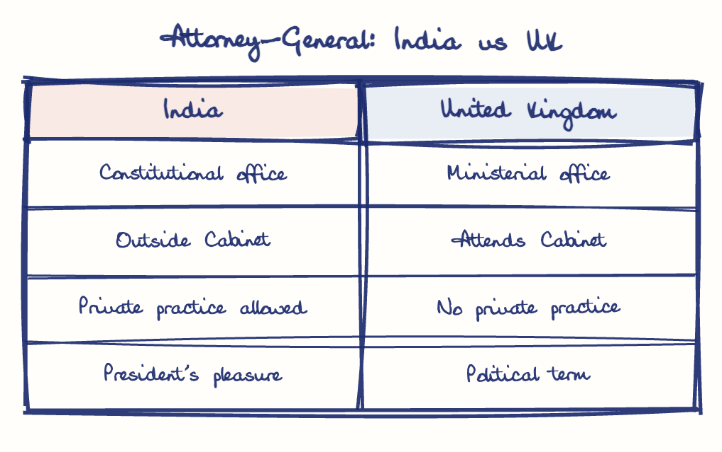
Under Article 76 the Attorney-General is the Union's foremost legal adviser and its counsel in the Supreme Court, with audience in every court and a voice in Parliament without a vote. Yet tenure at the President's pleasure and private practice limit the independence the office needs.
Model answer
Ghissu Editorial · Verified 4 Oct 2026 · 324 words
Legal adviser
Under Article 76(2) the AG advises the Union on matters the President refers, a standing set by M.C. Setalvad, the first AG (1950-63).
Union's counsel
The Law Officers Rules, 1987 make the AG appear for the Union in the Supreme Court, as Mukul Rohatgi did in 2015 when he argued privacy was not a fundamental right.
Wider reach
Article 76(3) gives audience in every court, Article 88 a voice in Parliament without a vote, and the Contempt of Courts Act, 1971 makes the AG's or Solicitor General's consent the filter for private contempt petitions.
Part-time and shared
The AG is not a government servant, may keep a private practice, and shares litigation with the Solicitor General.
Tenure at pleasure
With no fixed term, AGs customarily resign when governments change.
Client versus Constitution
In ADM Jabalpur (1976), AG Niren De argued even the right to life was unenforceable during the Emergency.
Secure and full-time
A fixed term, removal only for cause and an end to private practice would let the AG advise without fear.
This model answer is indicative and the model can make mistakes; please verify key facts independently.
Practise this question
1Get the answer sheet
Sized for this question.
2Write your answer
Timed, by hand.
3Get it marked
Your score and what to fix.
This chapter in the exam
Constitutional Bodies14 questions
Asked in 9 of 14 sittings since 2013
- 2026Is the right to vote a fundamental right ? Discuss the position of the Election Commission of India while undertaking the revision of electoral rolls. Can it also examine the question of citizenship of voters ?
- 2026Do constitutional bodies like the National Commission for Scheduled Castes (NCSC) and the National Commission for Scheduled Tribes (NCST) possess adequate enforcement powers to secure substantive social equality ? Suggest measures to enhance their institutional effectiveness.
All 14 questions, sorted by sub-topic, with model answers and practice.
Question from the official UPSC Civil Services (Main) Examination 2019 paper. Answer written by Ghissu's engine and checked against our editorial standards. Found an error? Tell us and we correct it within 48 hours.