2019 · GS Paper 2 · Q2 · 10 marks
The Central Administration Tribunal which was established for redressal of grievances and complaints by or against central government employees, nowadays is exercising its powers as an independent judicial authority. Explain.
In short
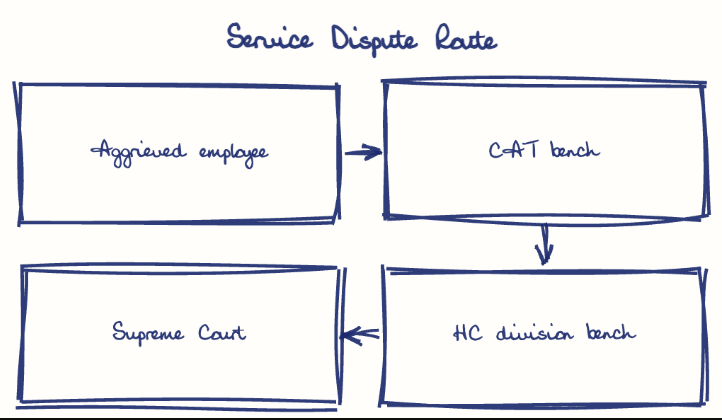
The Central Administrative Tribunal now works as a court of first instance with High Court powers whose orders bind the Union, subject only to High Court review. L. Chandra Kumar (1997) made it the mandatory first forum and let it test service rules.
Model answer
Ghissu Editorial · Verified 4 Oct 2026 · 271 words
High Court powers
Section 17 of the Administrative Tribunals Act 1985 gives CAT contempt powers like a High Court, and Section 22 binds it to natural justice instead of the Civil Procedure Code.
Exclusive first forum
L. Chandra Kumar (1997) required service litigants to approach CAT first, and allowed it to test statutes and rules, except its parent Act, against Articles 14 and 16.
Binding orders
Benches led by judicial members quash dismissals and set aside promotions or transfers, and ministries must comply.
High Court supervision
Every CAT order can be challenged before a High Court division bench, and Alapan Bandyopadhyay (2022) held this must be the High Court with territorial jurisdiction over the bench.
Executive control
CAT's budget and administration sit with the Department of Personnel and Training, itself a frequent litigant before it.
Tenure concerns
Rojer Mathew (2019) and Madras Bar Association (2020, 2021) struck down short tenures and executive-led selection, and bench vacancies still delay hearings.
This model answer is indicative and the model can make mistakes; please verify key facts independently.
Practise this question
1Get the answer sheet
Sized for this question.
2Write your answer
Timed, by hand.
3Get it marked
Your score and what to fix.
This chapter in the exam
Structure, Organization and Functioning of the States Judiciary4 questions
Asked in 4 of 14 sittings since 2013
- 2025Comment on the need of administrative tribunals as compared to the court system. Assess the impact of the recent tribunal reforms through rationalization of tribunals made in 2021.
- 2024Explain and distinguish between Lok Adalats and Arbitration Tribunals. Whether they entertain civil as well as criminal cases?
All 4 questions, sorted by sub-topic, with model answers and practice.
Question from the official UPSC Civil Services (Main) Examination 2019 paper. Answer written by Ghissu's engine and checked against our editorial standards. Found an error? Tell us and we correct it within 48 hours.