2019 · GS Paper 2 · Q9 · 10 marks
The time has come for India and Japan to build a strong contemporary relationship, one involving global and strategic partnership that will have a great significance for Asia and the world as a whole.' Comment.
In short
India and Japan have built a Special Strategic and Global Partnership that steadies Asia through security cooperation, investment and the Quad, though trade still lags strategy. The 2020 Acquisition and Cross-Servicing Agreement and Japan's funding of the Mumbai-Ahmedabad High Speed Rail mark its depth.
Model answer
Ghissu Editorial · Verified 4 Oct 2026 · 271 words
Security convergence
The 2+2 dialogue (since 2019), the Acquisition and Cross-Servicing Agreement (2020) and exercises like JIMEX and Malabar make Japan a close security partner.
Investment and infrastructure
Japan, India's largest bilateral ODA donor, funds the Mumbai-Ahmedabad High Speed Rail, and the 2025 summit targeted 10 trillion yen of private investment over a decade.
Trust and technology
The 2016 civil nuclear agreement, Japan's first with a non-NPT state, and over 100 Japanese capability centres in India (Deloitte, 2026) show deep trust.
A multipolar Asia
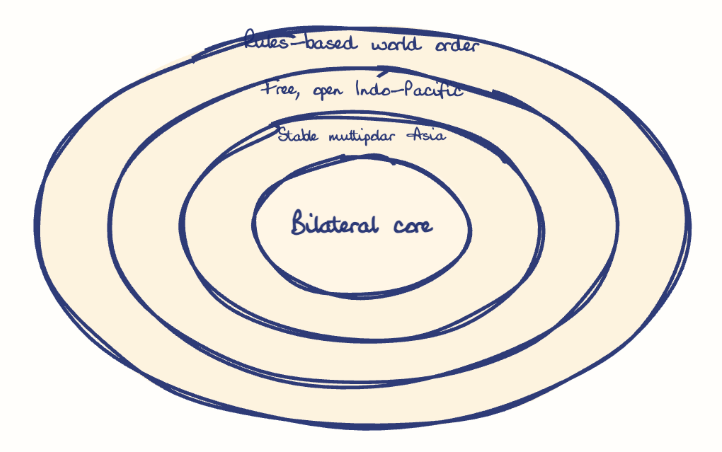
Through the Quad and the Free and Open Indo-Pacific vision, the two democracies balance China's assertiveness at sea and on the LAC.
Resilient supply chains
The Supply Chain Resilience Initiative with Australia (2021) offers alternatives to concentration in China.
Global governance
As G4 members, both seek UNSC reform and uphold UNCLOS.
Gaps to close
Trade under the 2011 CEPA stays modest, the bullet train is delayed and the Asia-Africa Growth Corridor has stalled.
This model answer is indicative and the model can make mistakes; please verify key facts independently.
Practise this question
1Get the answer sheet
Sized for this question.
2Write your answer
Timed, by hand.
3Get it marked
Your score and what to fix.
This chapter in the exam
Bilateral7 questions
Asked in 6 of 14 sittings since 2013
- 2025India-Africa digital partnership is achieving mutual respect, co-development and long-term institutional partnerships. Elaborate.
- 2021"If the last few decades were of Asia's growth story, the next few are expected to be of Africa's." In the light of this statement, examine India's influence in Africa in recent years.
All 7 questions, sorted by sub-topic, with model answers and practice.
Question from the official UPSC Civil Services (Main) Examination 2019 paper. Answer written by Ghissu's engine and checked against our editorial standards. Found an error? Tell us and we correct it within 48 hours.