2019 · GS Paper 3 · Q4 · 10 marks
Elaborate the impact of National Watershed Project in increasing agricultural production from water-stressed areas.
In short
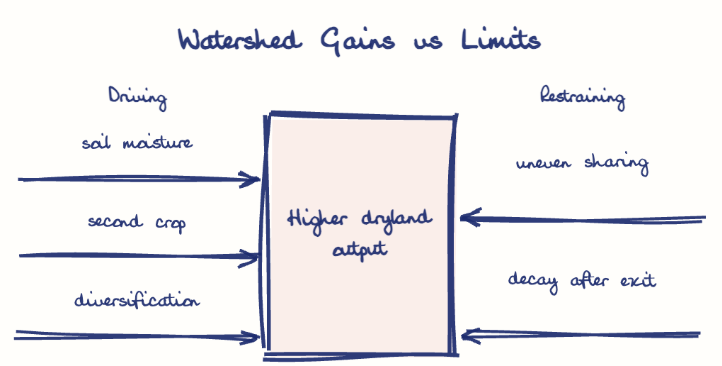
Watershed projects raise output in water-stressed areas by holding rain in soil and aquifers, enabling a second crop, diversification and stable yields. ICRISAT's meta-analysis of hundreds of watershed studies (2005) found irrigated area up about 52% and cropping intensity up about 35%.
Model answer
Ghissu Editorial · Verified 4 Oct 2026 · 276 words
Moisture where it falls
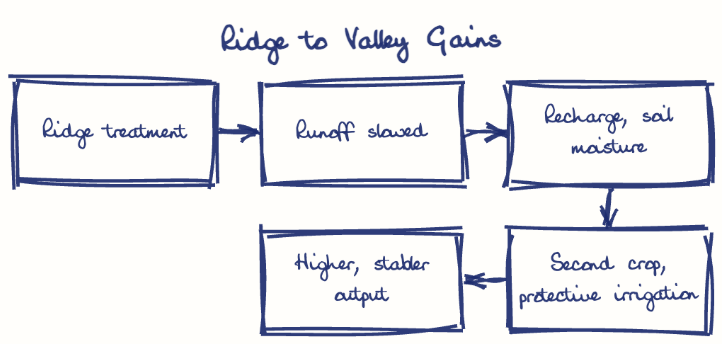
Contour bunds and check dams hold rain in the soil, so kharif crops survive dry spells.
A second season
Recharged wells and farm ponds give protective irrigation for rabi, raising cropping intensity.
Diversification
Assured moisture supports horticulture, fodder and dairy, spreading drought risk across more income streams.
Healthier land
Less erosion keeps topsoil and nutrients on the field, and Neeranchal's hydrological monitoring measures the gains.
Evidence at scale
ICRISAT's meta-analysis of hundreds of watershed studies (2005) found a benefit-cost ratio of about 2, with irrigated area up about 52% and cropping intensity up about 35%.
Model villages
Ralegan Siddhi and Hiware Bazar in drought-prone Ahmednagar moved from water tankers to multiple crops through community watersheds, and ICRISAT's Kothapally site recorded higher yields.
Uneven sharing
Valley landowners gain most, while the landless and graziers gain little.
Fading after exit
The Parthasarathy Committee (2006) found structures decaying after funding ended, prompting the Common Guidelines (2008).
This model answer is indicative and the model can make mistakes; please verify key facts independently.
Practise this question
1Get the answer sheet
Sized for this question.
2Write your answer
Timed, by hand.
3Get it marked
Your score and what to fix.
This chapter in the exam
Irrigation5 questions
Asked in 5 of 14 sittings since 2013
- 2024What are the major challenges faced by Indian irrigation system in recent times? State the measures taken by the government for efficient irrigation management.
- 2021How and to what extent would micro-irrigation help in solving India's water crisis ?
All 5 questions, sorted by sub-topic, with model answers and practice.
Question from the official UPSC Civil Services (Main) Examination 2019 paper. Answer written by Ghissu's engine and checked against our editorial standards. Found an error? Tell us and we correct it within 48 hours.