2021 · GS Paper 3 · Q4 · 10 marks
How and to what extent would micro-irrigation help in solving India's water crisis ?
In short
Micro-irrigation eases India's water crisis by cutting field losses, relieving aquifers and raising crop per drop, but only partially. Paddy and sugarcane resist conversion, and saved water often expands irrigated area, the paradox of irrigation efficiency documented in Science in 2018.
Model answer
Ghissu Editorial · Verified 4 Oct 2026 · 288 words
Cutting field losses
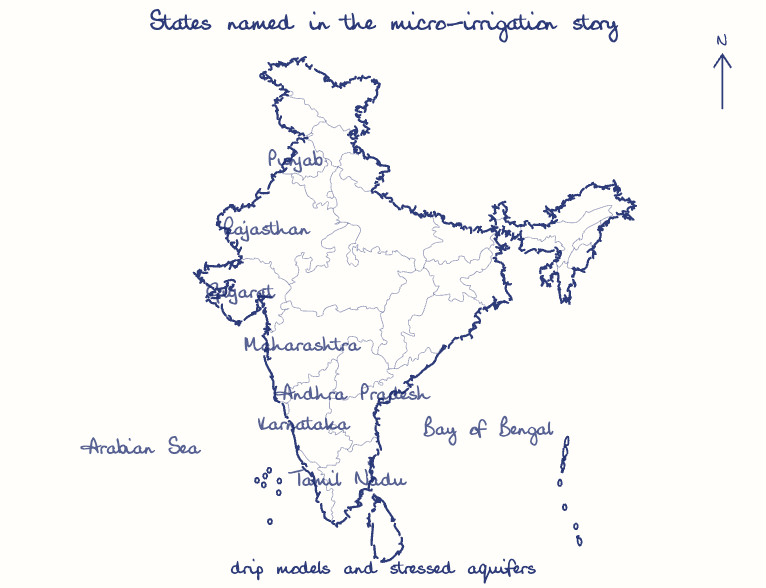
Drip and sprinklers replace flooding, where water is lost to evaporation and runoff, so the same crop needs far less water, as Karnataka's community drip project at Ramthal in Bagalkot shows.
Relieving aquifers
Lower pumping slows falling water tables in over-exploited blocks and trims the power subsidy bill in Punjab and Rajasthan.
More crop per drop
Fertigation raises yields and saves fertiliser, while less leaching protects groundwater quality and prevents waterlogging and salinity.
Delivery models
Gujarat Green Revolution Company, PMKSY's Per Drop More Crop and NABARD's Rs 5,000 crore Micro Irrigation Fund spread adoption.
Crop mismatch
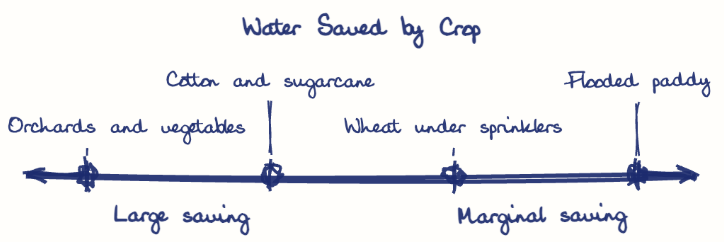
Paddy and sugarcane, the thirstiest crops, are the hardest to convert, and Maharashtra's 2017 drip push for sugarcane has moved slowly.
Rebound effect
Saved water often expands irrigated area, the "paradox of irrigation efficiency" (Grafton et al., Science, 2018).
Adoption barriers
High cost, small holdings and weak servicing keep coverage far below the 69.5 million hectare potential estimated by the 2004 Task Force.
Wider crisis
Urban leakage, pollution and lost wetlands lie outside the farm.
This model answer is indicative and the model can make mistakes; please verify key facts independently.
Practise this question
1Get the answer sheet
Sized for this question.
2Write your answer
Timed, by hand.
3Get it marked
Your score and what to fix.
This chapter in the exam
Irrigation5 questions
Asked in 5 of 14 sittings since 2013
- 2024What are the major challenges faced by Indian irrigation system in recent times? State the measures taken by the government for efficient irrigation management.
- 2020Suggest measures to improve water storage and irrigation system to make its judicious use under depleting scenario.
All 5 questions, sorted by sub-topic, with model answers and practice.
Question from the official UPSC Civil Services (Main) Examination 2021 paper. Answer written by Ghissu's engine and checked against our editorial standards. Found an error? Tell us and we correct it within 48 hours.