2019 · GS Paper 4 · Q6(b) · 10 marks
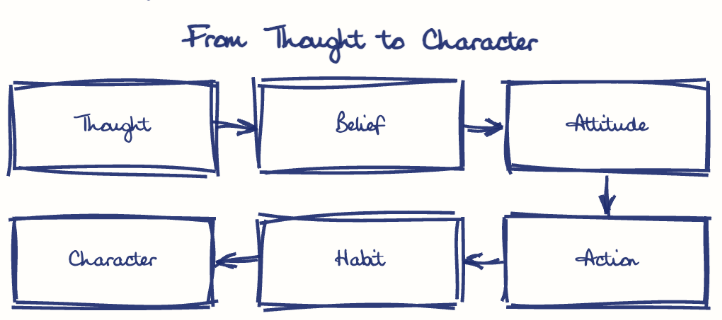
what do each of the following quotations mean to you? "A man is but a product of his thoughts. What he thinks he becomes." — M. K. Gandhi
In short
Gandhi's quote means that character is built by the thoughts a person chooses to nurture, so ethics begins as an inner discipline. Ambedkar likewise called caste a state of the mind, which is why laws like Article 17 work fully only when such thinking is unlearnt.
Model answer
Ghissu Editorial · Verified 4 Oct 2026 · 287 words
Self as its own maker
The Bhagavad Gita (6.5) holds that the self alone is its own friend and its own foe, so what the mind dwells upon hardens into disposition.
Belief steers conduct
When action departs from belief, Cognitive Dissonance pulls conduct back into line with what we think.
Gandhi's own life
The 1893 eviction at Pietermaritzburg could have bred bitterness; he chose to resist injustice without hatred, and that thought grew into satyagraha.
Integrity begins inside
The thought that "a small gift harms no one" starts an Ethical Slippage that ends in routine corruption, so vigilance starts in the mind.
Mindset shapes institutions
E. Sreedharan's discipline built the work culture that finished Delhi Metro's first phase ahead of schedule.
Prejudice is a thought
Ambedkar called caste "a state of the mind" in Annihilation of Caste (1936); Article 17 works fully only when that notion is unlearnt.
Limits of the idea
Thought is necessary but not sufficient; poverty and institutions also shape people, so good intent needs effort and fair structures.
This model answer is indicative and the model can make mistakes; please verify key facts independently.
Practise this question
1Get the answer sheet
Sized for this question.
2Write your answer
Timed, by hand.
3Get it marked
Your score and what to fix.
This chapter in the exam
Contributions of moral thinkers and philosophers from India23 questions
Asked in 13 of 14 sittings since 2013
- 2026In what ways can an Indian Administrative Officer apply Gandhi's notion of 'trusteeship' to ensure fairness in governance?
- 2025What do each of these quotations convey to you in the present context? "Those who in trouble untroubled are, Will trouble trouble itself." – Thiruvalluvar
All 23 questions, sorted by sub-topic, with model answers and practice.
Question from the official UPSC Civil Services (Main) Examination 2019 paper. Answer written by Ghissu's engine and checked against our editorial standards. Found an error? Tell us and we correct it within 48 hours.