2020 · GS Paper 1 · Q10 · 10 marks
Do you agree that regionalism in India appears to be a consequence of rising cultural assertiveness ? Argue.
In short
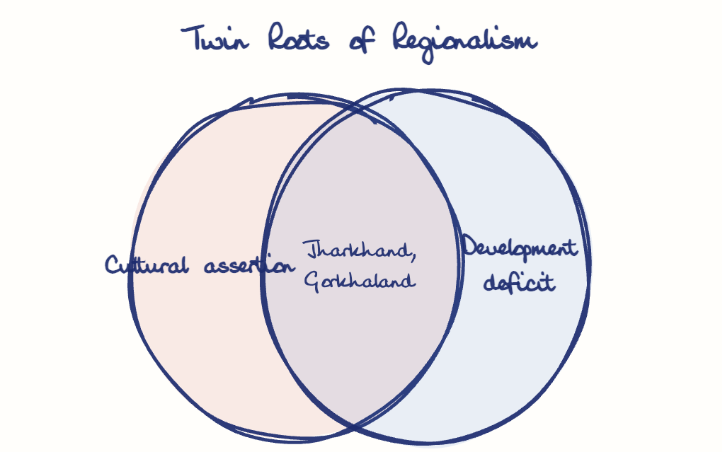
Regionalism in India is only partly a consequence of rising cultural assertiveness, since uneven development, federal grievance and elite mobilisation also drive it. Telugu-speaking Telangana's 2014 separation over water, funds and jobs shows that a shared culture does not prevent regional demands.
Model answer
Ghissu Editorial · Verified 4 Oct 2026 · 285 words
Language as identity
Potti Sriramulu's fatal fast in 1952 forced the creation of Andhra State in 1953, and the States Reorganisation Act, 1956 redrew India largely on linguistic lines.
Resisting homogenisation
The 1965 anti-Hindi agitation in Tamil Nadu and Maharashtra's 2025 withdrawal of its orders on Hindi as a third language show regions mobilising against a perceived cultural centre.
Ethnic distinctiveness
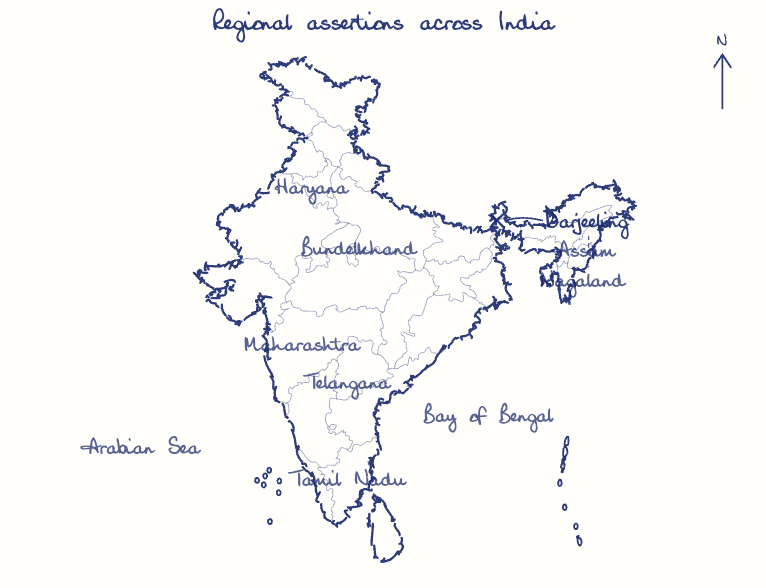
The Naga movement won Nagaland in 1963 and the protection of Article 371A, while Assam's anti-CAA protests invoked the Assam Accord of 1985 to guard Assamese identity.
Same culture, separate states
Telugu-speaking Telangana separated from Andhra Pradesh in 2014 over water, funds and jobs, not language.
Uneven development
Vidarbha and Bundelkhand seek statehood over agrarian distress and neglect, reflecting uneven modernisation.
Elite mobilisation
Paul Brass showed that elites select and politicise cultural markers to win power, so parties often amplify culture strategically.
Federal grievances
Southern states' complaints over tax devolution and post-Census delimitation are fiscal and political, not cultural, claims.
This model answer is indicative and the model can make mistakes; please verify key facts independently.
Practise this question
1Get the answer sheet
Sized for this question.
2Write your answer
Timed, by hand.
3Get it marked
Your score and what to fix.
This chapter in the exam
Regionalism4 questions
Asked in 4 of 14 sittings since 2013
- 2024What is regional disparity? How does it differ from diversity? How serious is the issue of regional disparity in India?
- 2016What is the basis of regionalism? Is it that unequal distribution of benefits of development on regional basis eventually promotes regionalism? Substantiate your answer.
All 4 questions, sorted by sub-topic, with model answers and practice.
Question from the official UPSC Civil Services (Main) Examination 2020 paper. Answer written by Ghissu's engine and checked against our editorial standards. Found an error? Tell us and we correct it within 48 hours.