2020 · GS Paper 1 · Q12 · 15 marks
Persian literary sources of medieval India reflect the spirit of the age. Comment.
In short
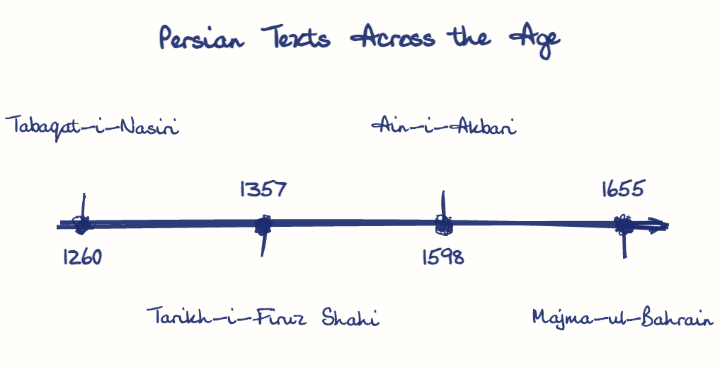
Persian sources such as the Tarikh-i-Firuz Shahi, the Ain-i-Akbari and Dara Shikoh's works mirror medieval India's kingship, administration and Indo-Persian synthesis, but mainly from the court's viewpoint. The Ain-i-Akbari's revenue and price records remain the richest window on the Mughal economy.
Model answer
Ghissu Editorial · Verified 4 Oct 2026 · 276 words
Ideology of kingship
Barani defends the Sultan's zawabit beside the sharia, while Abul Fazl's Akbarnama clothes Akbar in farr-i-izadi and sulh-i-kul.
Administration and economy
The Ain-i-Akbari records the dahsala system, mansab ranks and prices, the base of Irfan Habib's Agrarian System of Mughal India (1963).
Synthesis and piety
Amir Khusrau's Hindavi verse, the Razmnama, Dara Shikoh's Majma-ul-Bahrain and the malfuzat Fawaid-ul-Fuad show an Indo-Persian meeting of faiths.
Debate and private voice
Badauni's secret critique of Akbar and Gulbadan Begum's Humayun-nama show argument, not one official mood.
Court-centred bias
Chroniclers wrote for patrons, and Barani's contempt for the low-born colours his account.
Silence on the many
Peasants, artisans and most women barely appear, and regional life survives better in khyats and Bhakti verse.
Religious framing
Campaigns told as holy war were picked by Elliot and Dowson (1867-77) to paint perpetual communal conflict.
Corroborate and conserve
Read chronicles beside inscriptions, coins and travellers such as Bernier, and digitise Persian manuscripts under the National Mission for Manuscripts (2003).
This model answer is indicative and the model can make mistakes; please verify key facts independently.
Practise this question
1Get the answer sheet
Sized for this question.
2Write your answer
Timed, by hand.
3Get it marked
Your score and what to fix.
This chapter in the exam
Literature5 questions
Asked in 5 of 14 sittings since 2013
- 2024Estimate the contribution of Pallavas of Kanchi for the development of art and literature of South India.
- 2021Evaluate the nature of the Bhakti literature and its contribution to Indian culture.
All 5 questions, sorted by sub-topic, with model answers and practice.
Question from the official UPSC Civil Services (Main) Examination 2020 paper. Answer written by Ghissu's engine and checked against our editorial standards. Found an error? Tell us and we correct it within 48 hours.