2020 · GS Paper 2 · Q13 · 15 marks
The strength sustenance of local institutions in India has shifted from their formative phase of Functions, Functionaries and Funds to the contemporary stage of Functionality. Highlight the critical challenges faced by local institutions in terms of their functionality in recent times.
In short
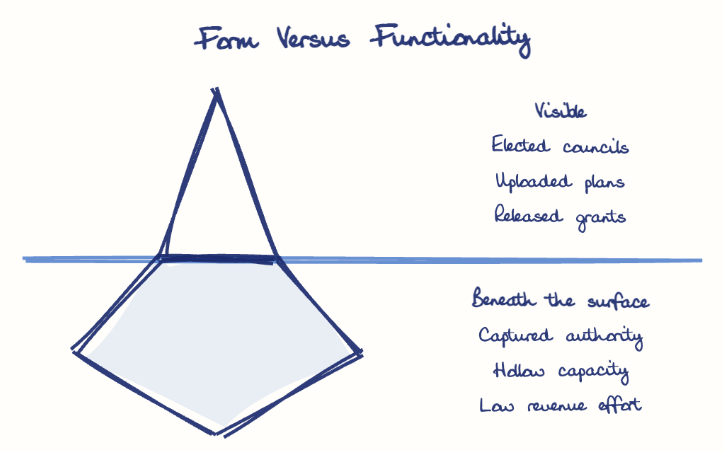
Local institutions now struggle less with formal devolution than with functioning, held back by parallel agencies, superseded councils, proxy leaders, thin staff, tick-box planning and tied funds. Only 25 of 28 states had constituted State Finance Commissions by 2025.
Model answer
Ghissu Editorial · Verified 4 Oct 2026 · 273 words
Parallel agencies
Smart Cities Mission SPVs (2015) and state parastatals execute projects outside elected councils, leaving them spectators.
Administrators instead of councils
Maharashtra's municipal corporations ran under administrators from 2022 until the Supreme Court ordered polls in 2025, despite Article 243U.
Proxy leadership
The "pradhan pati" practice, examined by the Sushil Kumar Advisory Committee (2023), hollows out women's reservation.
Thin functionaries
Many Gram Panchayats share a secretary and lack engineers and accountants, so plans stall at execution.
Tick-box planning
Only 4.57% of Gram Panchayats built a women-friendly theme into their 2024-25 plans, and District Planning Committees rarely meet.
Tied and delayed funds
60% of 15th Finance Commission rural grants were tied, and only 25 of 28 states had State Finance Commissions by 2025.
Activity mapping
Match each function with staff and money, as the 2nd ARC (2007) urged.
Revenue effort
Use SVAMITVA property cards to widen property tax and reward it through performance grants.
Accountability
Penalise proxies and make social audit routine.
This model answer is indicative and the model can make mistakes; please verify key facts independently.
Practise this question
1Get the answer sheet
Sized for this question.
2Write your answer
Timed, by hand.
3Get it marked
Your score and what to fix.
This chapter in the exam
Devolution — Panchayati Raj6 questions
Asked in 6 of 14 sittings since 2013
- 2022To what extent, in your opinion, has the decentralisation of power in India changed the governance landscape at the grassroots?
- 2018Assess the importance of the Panchayat system in India as a part of local government. Apart from government grants, what sources the Panchayats can look out for financing developmental projects?
All 6 questions, sorted by sub-topic, with model answers and practice.
Question from the official UPSC Civil Services (Main) Examination 2020 paper. Answer written by Ghissu's engine and checked against our editorial standards. Found an error? Tell us and we correct it within 48 hours.