2022 · GS Paper 2 · Q3 · 10 marks
To what extent, in your opinion, has the decentralisation of power in India changed the governance landscape at the grassroots?
In short
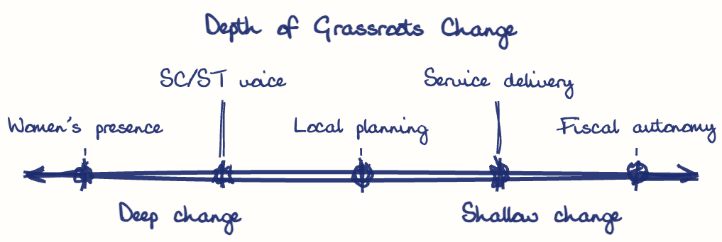
Decentralisation has largely changed who governs at the grassroots, through women's and SC/ST representation and participatory planning, but only partially what local bodies control. The Panchayat Devolution Index rose only from 39.9% in 2013-14 to 43.9% in 2021-22.
Model answer
Ghissu Editorial · Verified 4 Oct 2026 · 290 words
Representation
Nearly half of elected panchayat members are women, and Chattopadhyay and Duflo (2004) found women pradhans invested more in drinking water.
Margins empowered
Article 243D reservation seated SC and ST leaders, and using PESA (1996) and forest-rights powers, the Niyamgiri Gram Sabhas rejected bauxite mining in 2013.
Participatory planning
Over 17.73 lakh Gram Panchayat Development Plans were uploaded between 2019-20 and 2025-26 (PIB, 2025), Kerala's People's Plan (1996) devolved over a third of plan funds, and MGNREGA social audits opened local spending to village scrutiny.
Partial devolution
The Panchayat Devolution Index rose only from 39.9% (2013-14) to 43.9% (2021-22), leaving most Eleventh Schedule subjects with line departments.
Fiscal dependence
Panchayats raise little of their own revenue and live on grants, 60% of the 15th Finance Commission's rural grants being tied to water and sanitation.
Proxy and capture
"Pradhan pati" proxies, examined by the Sushil Kumar Advisory Committee (2023), and caste elites blunt women's and Dalit leadership.
State control
Only 25 of 28 states had constituted State Finance Commissions by 2025, and delayed elections leave bodies under officials.
This model answer is indicative and the model can make mistakes; please verify key facts independently.
Practise this question
1Get the answer sheet
Sized for this question.
2Write your answer
Timed, by hand.
3Get it marked
Your score and what to fix.
This chapter in the exam
Devolution — Panchayati Raj6 questions
Asked in 6 of 14 sittings since 2013
- 2020The strength sustenance of local institutions in India has shifted from their formative phase of Functions, Functionaries and Funds to the contemporary stage of Functionality. Highlight the critical challenges faced by local institutions in terms of their functionality in recent times.
- 2018Assess the importance of the Panchayat system in India as a part of local government. Apart from government grants, what sources the Panchayats can look out for financing developmental projects?
All 6 questions, sorted by sub-topic, with model answers and practice.
Question from the official UPSC Civil Services (Main) Examination 2022 paper. Answer written by Ghissu's engine and checked against our editorial standards. Found an error? Tell us and we correct it within 48 hours.