2020 · GS Paper 3 · Q1 · 10 marks
Explain intra-generational and inter-generational issues of equity from the perspective of inclusive growth and sustainable development.
In short
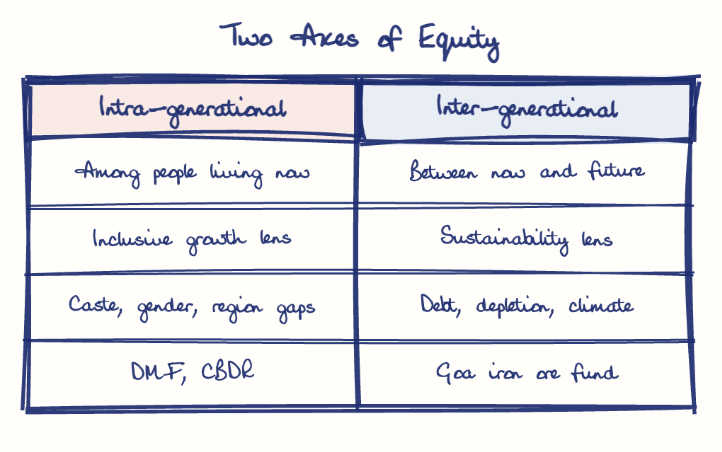
Intra-generational equity means sharing growth's gains and costs fairly among people alive today, the core of inclusive growth, while inter-generational equity means preserving resources for future generations, the core of sustainability. The Goa Foundation judgment (2014) applied the latter through the Goa Iron Ore Permanent Fund.
Model answer
Ghissu Editorial · Verified 4 Oct 2026 · 296 words
Fair shares today
It asks whether gains and costs are shared fairly across income, caste, gender and region; the top 1% holding 22.6% of income (World Inequality Lab, 2024) shows the gap.
Unequal burdens
Jharia's unregulated coal mining has caused fires, subsidence and displacement among those who gain least from it (RIS, 2025), which the District Mineral Foundation (2015) seeks to redress by returning mining revenue locally.
Between nations
Common But Differentiated Responsibilities (Rio, 1992) gives developing countries space to grow while richer nations bear the larger climate burden.
Trust for the future
Natural and fiscal resources are held in trust for those not yet born, a principle the Supreme Court invoked in Ganesh Wood Products (1995).
Natural capital
Exhausting minerals and groundwater robs the future, so the Goa Foundation judgment (2014) led to the Goa Iron Ore Permanent Fund, saving mineral rents for the unborn.
Climate and debt
Emissions and unfunded liabilities pass costs forward, so the net-zero 2070 pledge (COP26, 2021) and the FRBM limits on debt keep today's choices from burdening tomorrow's citizens.
This model answer is indicative and the model can make mistakes; please verify key facts independently.
Practise this question
1Get the answer sheet
Sized for this question.
2Write your answer
Timed, by hand.
3Get it marked
Your score and what to fix.
This chapter in the exam
Inclusive Growth11 questions
Asked in 9 of 14 sittings since 2013
- 2026Examine the view that financial inclusion is an integral part of social and economic inclusion in a country like India. Also throw light on the usefulness of the R.B.I.'s Financial Inclusion Index. (Answer in 150 words)
- 2023Distinguish between 'care economy' and 'monetized economy'. How can care economy be brought into monetized economy through women empowerment?
All 11 questions, sorted by sub-topic, with model answers and practice.
Question from the official UPSC Civil Services (Main) Examination 2020 paper. Answer written by Ghissu's engine and checked against our editorial standards. Found an error? Tell us and we correct it within 48 hours.