2020 · GS Paper 3 · Q7 · 10 marks
How does the draft Environment Impact Assessment (EIA) Notification, 2020 differ from the existing EIA Notification, 2006?
In short
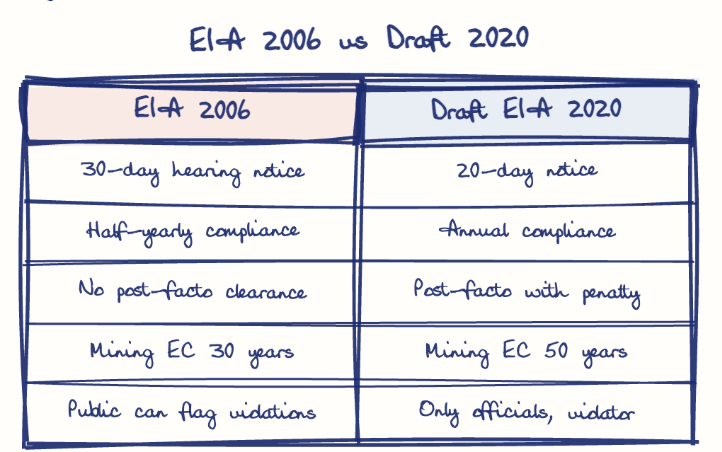
The draft EIA Notification 2020 differs from the 2006 regime by fixing exempt project categories, shortening public hearing notice and allowing post-facto clearance with penalties. Hearing notice falls from 30 to 20 days and compliance reports from half-yearly to annual.
Model answer
Ghissu Editorial · Verified 4 Oct 2026 · 303 words
Fixed Categories
The 2006 regime screened Category B projects case by case, while the draft fixes A, B1 and B2 and frees about 40 B2 types from EIA and public hearing.
Wider Exemptions
Strategic projects, linear projects within 100 km of the border and offshore projects beyond 12 nautical miles skip public hearing.
Expansion Relief
Expansion up to 25% needs no fresh clearance and up to 50% no public hearing, unlike the 2006 rule of appraising significant expansion.
Process Gains
New definitions of terms such as "protected area" and fixed appraisal timelines promise clearer, faster decisions.
Voice of the Affected
Ten fewer days of notice hurts tribal and remote communities, who need time and translated reports to study a project.
Prevention to Cure
Post-facto regularisation turns EIA into a fee, which *Alembic Pharmaceuticals* (2020) called alien to environmental law.
Monitoring Blind Spots
Annual reports and barring citizens from reporting violations leave damage unseen for longer, while 50-year mining clearances freeze old baselines.
This model answer is indicative and the model can make mistakes; please verify key facts independently.
Practise this question
1Get the answer sheet
Sized for this question.
2Write your answer
Timed, by hand.
3Get it marked
Your score and what to fix.
This chapter in the exam
Environmental Impact Assessment4 questions
Asked in 4 of 14 sittings since 2013
- 2024What role do environmental NGOs and activists play in influencing Environmental Impact Assessment (EIA) outcomes for major projects in India? Cite four examples with all important details.
- 2016Rehabilitation of human settlements is one of the important environmental impacts which always attracts controversy while planning major projects. Discuss the measures suggested for mitigation of this impact while proposing major developmental projects.
All 4 questions, sorted by sub-topic, with model answers and practice.
Question from the official UPSC Civil Services (Main) Examination 2020 paper. Answer written by Ghissu's engine and checked against our editorial standards. Found an error? Tell us and we correct it within 48 hours.