2020 · GS Paper 3 · Q3 · 10 marks
What are the main constraints in transport and marketing of agricultural produce in India?
In short
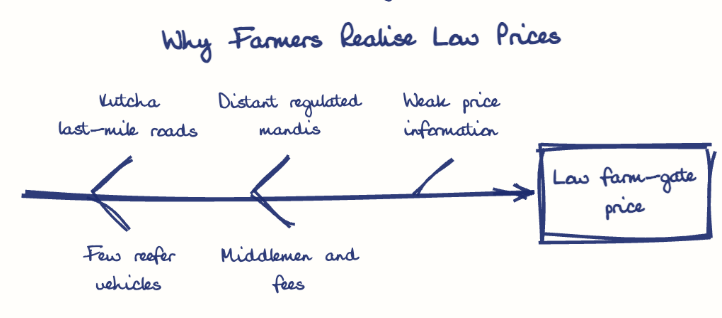
Transport is constrained by kutcha last-mile roads, missing reefer vehicles and costly small loads, while marketing suffers from distant mandis, layered intermediaries, no storage or credit and narrow procurement. Farmers receive only about a third of the consumer rupee for tomatoes, onions and potatoes (RBI, 2024).
Model answer
Ghissu Editorial · Verified 4 Oct 2026 · 276 words
Last-mile roads
Kutcha village roads mean produce moves by tractor-trolley or head-load and is damaged before reaching a market, despite PMGSY since 2000.
Missing cold transport
The NCCD's 2015 study found a gap of over 85% in reefer vehicles and over 99% in pack-houses.
Small lots and high freight
With about 86% small and marginal holdings (Agriculture Census 2015-16), per-quintal freight is high; Kisan Rail began only in August 2020.
Distant mandis
Regulated markets are far sparser than the one per 80 sq km recommended by the National Commission on Farmers (2006).
Intermediaries and fees
Farmers get only about a third of the consumer rupee for tomatoes, onions and potatoes (RBI working paper, 2024).
No holding power
Without grading, storage or warehouse-receipt finance, farmers sell ungraded produce at harvest to the commission agent who lent them money.
Narrow procurement
Only about 6% of farmers sold at MSP (Shanta Kumar Committee, 2015).
This model answer is indicative and the model can make mistakes; please verify key facts independently.
Practise this question
1Get the answer sheet
Sized for this question.
2Write your answer
Timed, by hand.
3Get it marked
Your score and what to fix.
This chapter in the exam
Storage, Transport and Marketing of Agricultural Produce5 questions
Asked in 5 of 14 sittings since 2013
- 2026Explain the factors responsible for inefficiency of agri-produce marketing. How e-commerce helps to reduce inefficiency of agri-produce marketing? Explain. (Answer in 150 words)
- 2025Elaborate the scope and significance of supply chain management of agricultural commodities in India.
All 5 questions, sorted by sub-topic, with model answers and practice.
Question from the official UPSC Civil Services (Main) Examination 2020 paper. Answer written by Ghissu's engine and checked against our editorial standards. Found an error? Tell us and we correct it within 48 hours.