2020 · GS Paper 4 · Q3(b) · 10 marks
'The will to power exists, but it can be tamed and be guided by rationality and principles of moral duty.' Examine this statement in the context of international relations.
In short
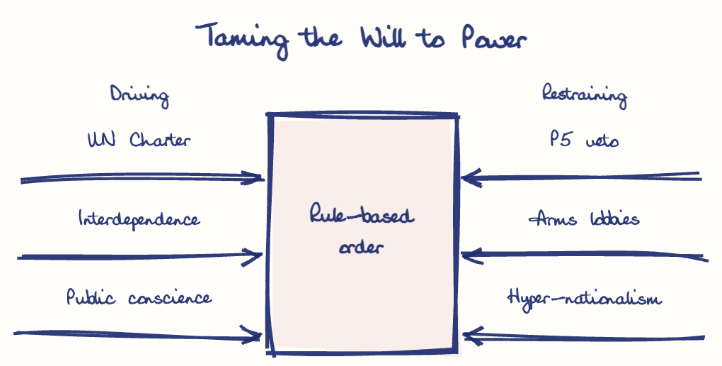
The will to power is real in international relations, but reason and moral duty can tame it through law, interdependence and conscience, though imperfectly. Article 2(4) of the UN Charter, the NPT and India's No First Use doctrine show power restrained by principle.
Model answer
Ghissu Editorial · Verified 4 Oct 2026 · 275 words
Realist reality
Thucydides' Melian Dialogue held that "the strong do what they can and the weak suffer what they must", as Russia's annexation of Crimea in 2014 showed.
Force without sanction
The US-led invasion of Iraq in 2003 went ahead without explicit Security Council authorisation.
Privileged institutions
The P5 veto lets power shield itself, paralysing the Council over Syria and Ukraine.
Rational self-restraint
Fear of mutual destruction produced the NPT (1968) and India's No First Use nuclear doctrine (2003).
Duty written into law
Article 2(4) of the UN Charter bans the use of force, and the Geneva Conventions (1949) bind armies even in war.
Power as service
India's Panchsheel (1954) and Vaccine Maitri (2021) show strength used as Lokasangraha, action for the common good.
Limits of the taming
The US withdrawal from the Paris Agreement, announced in 2017 and again in 2025, shows that interest can reverse commitments made by reason.
This model answer is indicative and the model can make mistakes; please verify key facts independently.
Practise this question
1Get the answer sheet
Sized for this question.
2Write your answer
Timed, by hand.
3Get it marked
Your score and what to fix.
This chapter in the exam
Ethical issues in international relations and funding9 questions
Asked in 9 of 14 sittings since 2013
- 2026In international relations, ethical considerations are often subjugated to the strategic interests of nation-states. Discuss this from an ethical perspective.
- 2025Carl von Clausewitz once said, "War is a diplomacy by other means." Critically analyse the above statement in the present context of contemporary geo-political conflict.
All 9 questions, sorted by sub-topic, with model answers and practice.
Question from the official UPSC Civil Services (Main) Examination 2020 paper. Answer written by Ghissu's engine and checked against our editorial standards. Found an error? Tell us and we correct it within 48 hours.