2020 · GS Paper 4 · Q3(a) · 10 marks
What teachings of Buddha are most relevant today and why? Discuss.
In short
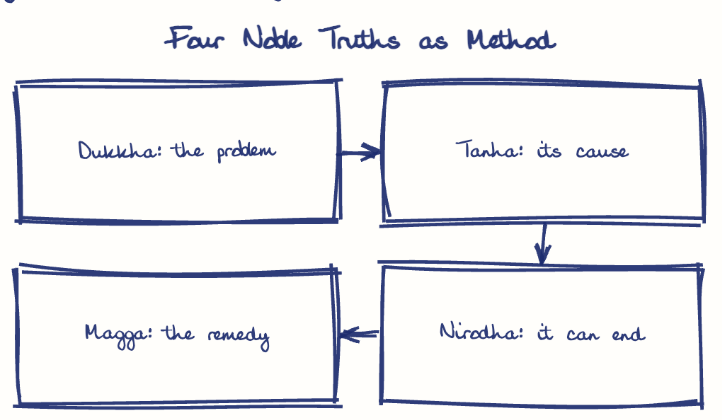
The Buddha's most relevant teachings today are the Middle Path, compassionate non-violence, equality, mindfulness and reasoned inquiry, because they address consumerism, conflict, discrimination and misinformation. The Four Noble Truths offer a rational method: identify the problem, its cause, that it can end, and the remedy.
Model answer
Ghissu Editorial · Verified 4 Oct 2026 · 280 words
Middle Path
Rejecting indulgence and severe austerity, it answers consumerism, an idea Mission LiFE (2022) applies to mindful consumption.
Ahimsa and Karuna
Compassionate non-violence offers a way out of wars; the Buddha is remembered for averting a Sakya-Koliya war over the Rohini river through dialogue.
Equality in the Sangha
The Sangha admitted every caste and Upali the barber became a leading monk; Ambedkar drew on this ethic at Nagpur on 14 October 1956.
Right Mindfulness
Mindfulness-based stress reduction by Jon Kabat-Zinn shows its value for a stressed generation.
Reason over authority
The Kalama Sutta asks people to test even the Buddha's words by experience, an antidote to the Confirmation Bias that misinformation feeds on.
Interdependence
Pratityasamutpada holds that nothing exists alone, the ethical core of climate responsibility and Intergenerational Equity.
Ethics in governance
After Kalinga, Ashoka made Dhamma state policy through welfare, tolerance and the Dhamma Mahamattas.
Right Livelihood
Earning without harming others challenges exploitative business models and supports responsible enterprise.
This model answer is indicative and the model can make mistakes; please verify key facts independently.
Practise this question
1Get the answer sheet
Sized for this question.
2Write your answer
Timed, by hand.
3Get it marked
Your score and what to fix.
This chapter in the exam
Contributions of moral thinkers and philosophers from India23 questions
Asked in 13 of 14 sittings since 2013
- 2026In what ways can an Indian Administrative Officer apply Gandhi's notion of 'trusteeship' to ensure fairness in governance?
- 2025What do each of these quotations convey to you in the present context? "Those who in trouble untroubled are, Will trouble trouble itself." – Thiruvalluvar
All 23 questions, sorted by sub-topic, with model answers and practice.
Question from the official UPSC Civil Services (Main) Examination 2020 paper. Answer written by Ghissu's engine and checked against our editorial standards. Found an error? Tell us and we correct it within 48 hours.