2021 · GS Paper 1 · Q3 · 10 marks
Assess the main administrative issues and socio-cultural problems in the integration process of Indian Princely States.
In short
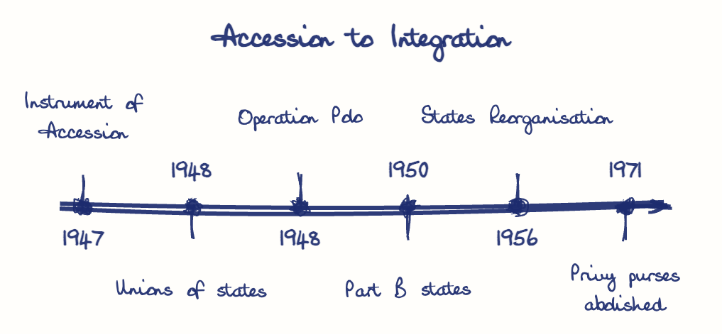
Integrating over 560 princely states raised administrative issues of limited accession, uneven governance, finances and coercion, and socio-cultural problems of princely prestige, communal tension, language and peripheral identity. Merger agreements, Part B states and the 1956 reorganisation settled administration within a decade.
Model answer
Ghissu Editorial · Verified 4 Oct 2026 · 282 words
Limited accession
The Instrument of Accession ceded only defence, external affairs and communications, so merger agreements had to fold 216 states into provinces, 61 into centrally administered units and 275 into five unions such as Saurashtra and PEPSU.
Uneven governance and finance
Most states lacked land records, courts and trained services, and had their own taxes and internal customs, a gap mapped by the V.T. Krishnamachari Committee (1948-49).
Coercion where consent failed
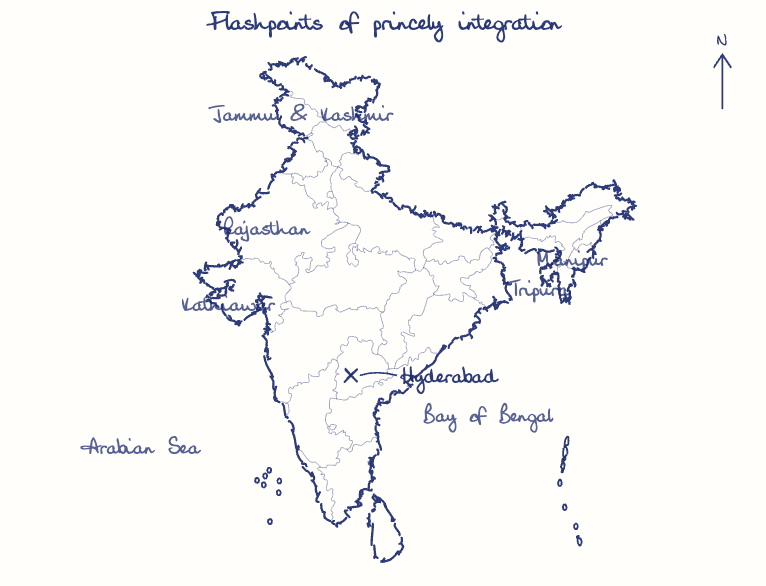
Junagadh needed a plebiscite (1948) and Hyderabad Operation Polo (1948), while Kashmir's accession amid a tribal invasion went to the UN.
Princely prestige
Rulers were won over with privy purses and Rajpramukh posts, a bargain at odds with republican equality until the 26th Amendment (1971).
Communal faultlines
Qasim Razvi's Razakars terrorised Hyderabad's largely Hindu population, so integration risked reopening Partition's wounds.
Linguistic and peripheral identities
Princely boundaries split Telugu, Marathi and Kannada speakers, feeding the 1956 reorganisation, while Manipur and Tripura, merged in 1949, felt annexed rather than consulted.
This model answer is indicative and the model can make mistakes; please verify key facts independently.
Practise this question
1Get the answer sheet
Sized for this question.
2Write your answer
Timed, by hand.
3Get it marked
Your score and what to fix.
This chapter in the exam
Political Consolidation (the "Integration" Phase)2 questions
Asked in 2 of 14 sittings since 2013
Question from the official UPSC Civil Services (Main) Examination 2021 paper. Answer written by Ghissu's engine and checked against our editorial standards. Found an error? Tell us and we correct it within 48 hours.