2025 · GS Paper 1 · Q12 · 15 marks
Trace India's consolidation process during early phase of independence in terms of polity, economy, education and international relations.
In short
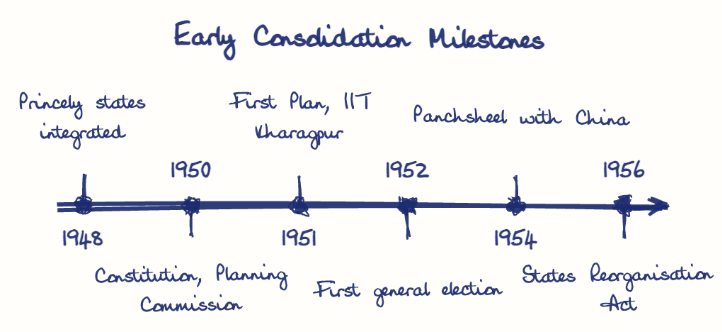
In its early years India consolidated a democratic polity, a planned mixed economy, national educational institutions and a non-aligned foreign policy. Over 560 princely states were merged and the 1951-52 general election enrolled about 17 crore voters under universal adult franchise.
Model answer
Ghissu Editorial · Verified 4 Oct 2026 · 300 words
Territorial and democratic unity
Over 560 princely states were merged by 1949, and the first general election of 1951-52 enrolled about 17 crore voters under universal adult franchise.
Accommodating diversity
After Andhra State (1953), the States Reorganisation Act, 1956, turned linguistic demands into federal units rather than secession.
Non-alignment
India stayed in the Commonwealth as a republic (1949), signed Panchsheel (1954) and helped shape Bandung (1955) and NAM (1961).
Planned mixed economy
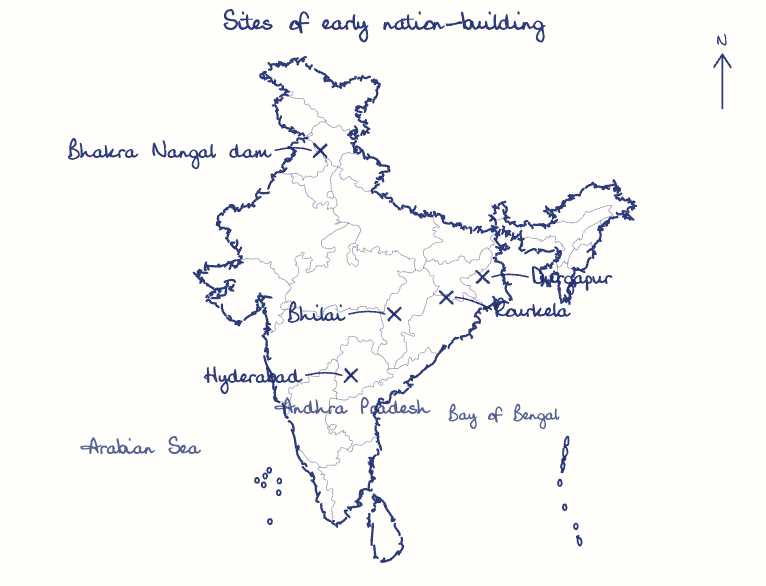
The Industrial Policy Resolutions of 1948 and 1956 and the Second Plan built steel plants at Bhilai, Rourkela and Durgapur, while zamindari abolition ended intermediaries.
Higher education
The Radhakrishnan Commission (1948-49), the UGC (1953), IIT Kharagpur (1951) and AIIMS (1956) built national institutions.
Mass schooling
With literacy at about 18% in 1951, Article 45 promised free schooling, yet primary education lagged behind elite institutions.
Accommodate diversity
Linguistic reorganisation shows that accommodation, not imposition, holds a diverse union together.
Foundations and capability
Foundational schooling must come first, and diplomacy needs hard capability, as the 1962 war showed.
This model answer is indicative and the model can make mistakes; please verify key facts independently.
Practise this question
1Get the answer sheet
Sized for this question.
2Write your answer
Timed, by hand.
3Get it marked
Your score and what to fix.
This chapter in the exam
Political Consolidation (the "Integration" Phase)2 questions
Asked in 2 of 14 sittings since 2013
Question from the official UPSC Civil Services (Main) Examination 2025 paper. Answer written by Ghissu's engine and checked against our editorial standards. Found an error? Tell us and we correct it within 48 hours.