2021 · GS Paper 1 · Q15 · 15 marks
How do the melting of the Arctic ice and glaciers of the Antarctic differently affect the weather patterns and human activities on the Earth? Explain.
In short
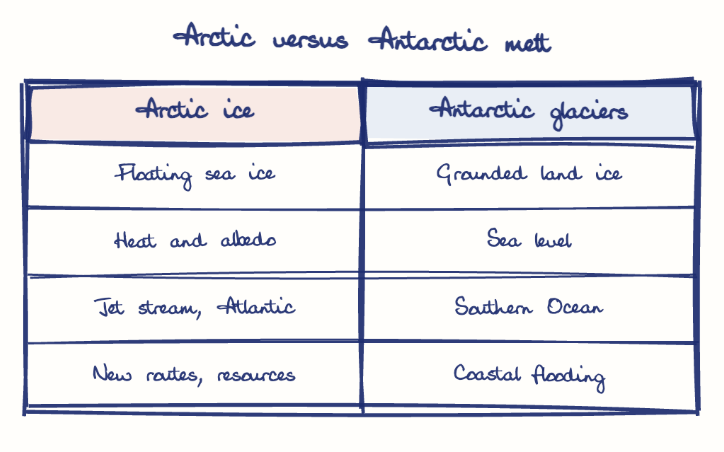
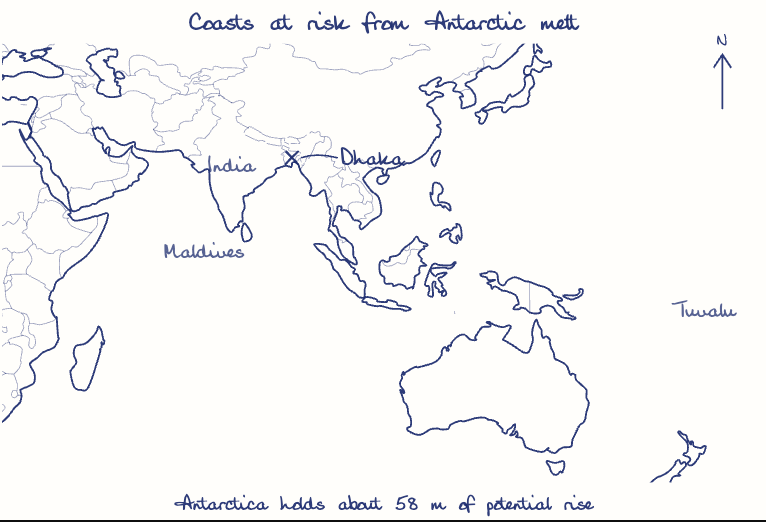
Melting Arctic sea ice mainly alters weather through heat absorption, a wavier jet stream and new shipping and resource frontiers, while melting Antarctic glaciers mainly raise sea level and slow Southern Ocean circulation. Antarctica holds about 58 m of potential sea-level rise, whereas floating Arctic ice adds almost none.
Model answer
Ghissu Editorial · Verified 4 Oct 2026 · 322 words
Arctic amplification
September sea ice is shrinking by about 13% a decade (NSIDC), and the darker ocean absorbs heat.
Northern extremes
A weaker temperature contrast is linked, though debated, to a wavier jet stream and cold outbreaks such as the Texas freeze (2021).
Ocean conveyors
Greenland melt is linked to a weakening Atlantic overturning circulation, while Antarctic meltwater could slow deep Southern Ocean overturning by about 40% by 2050 (Nature, 2023).
Rising seas
Floating Arctic ice adds little to sea level, but Antarctica holds about 58 m of potential rise, and Thwaites Glacier already adds about 4% of the global rise, threatening Kolkata, Mumbai and the Maldives.
Arctic opportunity
The Northern Sea Route can cut Europe-Asia voyages by up to about 40% and exposes oil and minerals to rivalry.
Governance contrast
sovereign Arctic states open their waters to commercial use, while the Antarctic Treaty (1959) and Madrid Protocol (1991) ban mining.
Emission cuts
Holding warming near 1.5°C under the Paris Agreement slows both poles.
Polar science and coasts
India's Arctic Policy (2022), the Indian Antarctic Act (2022) and coastal vulnerability mapping should guide delta planning.
This model answer is indicative and the model can make mistakes; please verify key facts independently.
Practise this question
1Get the answer sheet
Sized for this question.
2Write your answer
Timed, by hand.
3Get it marked
Your score and what to fix.
This chapter in the exam
Climate12 questions
Asked in 9 of 14 sittings since 2013
- 2026What is the Fujiwara effect? Explain its impact on the movement and intensity of tropical cyclones.
- 2026"Tundra regions are ecologically fragile but economically important." Examine this statement critically.
All 12 questions, sorted by sub-topic, with model answers and practice.
Question from the official UPSC Civil Services (Main) Examination 2021 paper. Answer written by Ghissu's engine and checked against our editorial standards. Found an error? Tell us and we correct it within 48 hours.