2021 · GS Paper 1 · Q17 · 15 marks
What are the main socio-economic implications arising out of the development of IT industries in major cities of India ?
In short
The IT industry has brought high-paying jobs, global investment and social change to India's major cities, but also land inflation, congestion, ecological loss and inequality. Bengaluru shows both sides: a global tech hub that TomTom's 2024 index ranked among the world's three slowest cities.
Model answer
Ghissu Editorial · Verified 4 Oct 2026 · 271 words
Jobs and investment
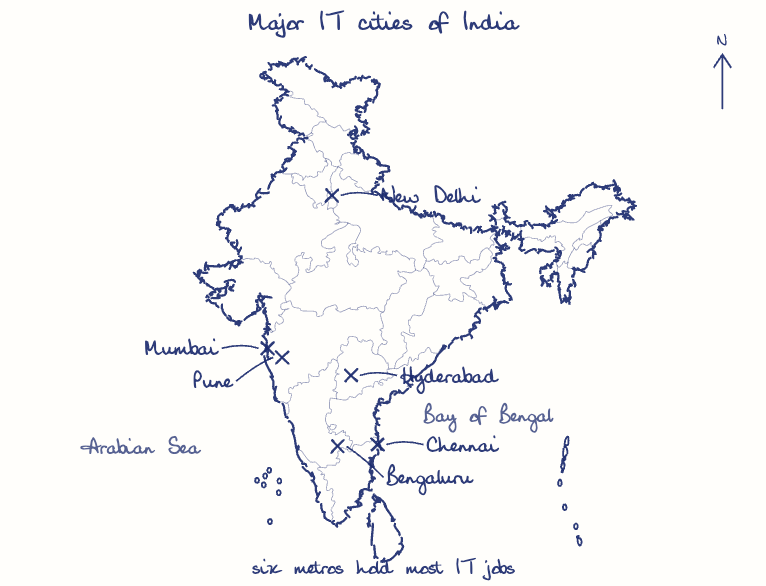
High IT salaries create indirect work in transport, retail and construction, and clusters like HITEC City and Hinjewadi now host most of India's 1,700 Global Capability Centres (NASSCOM-Zinnov, 2024).
Land inflation
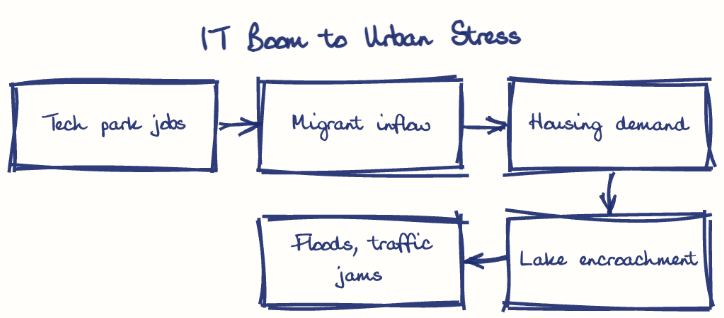
Rents and land prices have soared, pushing service workers to the urban fringe.
Volatile, concentrated growth
Gains stay in a few states, and global slowdowns hit hard, as with TCS's announced 12,000 job cuts in 2025.
Infrastructure strain
TomTom's 2024 index ranked Bengaluru among the world's three slowest cities, and the 2022 floods shut its Outer Ring Road tech corridor.
Women's work
About 36% of ITeS workers are women, though night shifts expose safety gaps.
Dual cities
Gated campuses sit beside slums, and migration fed nativist demands like Karnataka's shelved 2024 local-quota bill.
Disperse and plan
Spread IT to tier-2 cities through STPI and "Beyond Bengaluru", and apply transit-oriented development near tech parks.
Reskill
Scale FutureSkills Prime as AI automates routine work.
This model answer is indicative and the model can make mistakes; please verify key facts independently.
Practise this question
1Get the answer sheet
Sized for this question.
2Write your answer
Timed, by hand.
3Get it marked
Your score and what to fix.
This chapter in the exam
International Trade / Transport and Activities12 questions
Asked in 9 of 14 sittings since 2013
- 2026"The centre of global trade is gradually shifting from the Atlantic region to the Indo-Pacific region." Examine this statement.
- 2022Mention the significance of straits and isthmus in international trade.
All 12 questions, sorted by sub-topic, with model answers and practice.
Question from the official UPSC Civil Services (Main) Examination 2021 paper. Answer written by Ghissu's engine and checked against our editorial standards. Found an error? Tell us and we correct it within 48 hours.