2021 · GS Paper 2 · Q6 · 10 marks
"Besides being a moral imperative of a Welfare State, primary health structure is a necessary precondition for sustainable development." Analyze.
In short
Primary health care fulfils the welfare state's duty under Articles 47 and 21 and also builds the healthy human capital, poverty protection and resilience that sustainable development needs. Out-of-pocket health spending fell from 64.2% in 2013-14 to 39.4% in 2021-22 as public provision expanded.
Model answer
Ghissu Editorial · Verified 4 Oct 2026 · 273 words
Article 47 makes public health a primary duty of the State, and the Alma-Ata Declaration (1978) made primary care the key to "Health for All". Yet public health spending remains below 2% of GDP against the 2.5% goal of the National Health Policy 2017.
Primary Health as the Welfare State's Moral Duty
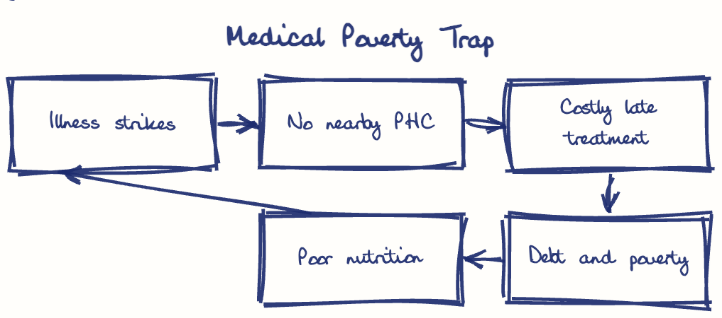
Medical Poverty Trap → Illness strikes → No nearby PHC → Costly late treatment → Debt and poverty → Poor nutrition
1. Right to life: Paschim Banga Khet Mazdoor Samity (1996) read timely medical care into Article 21, and the PHC is where this right is first delivered. 2. Protection from poverty: Out-of-pocket spending fell from 64.2% in 2013-14 to 39.4% in 2021-22 (National Health Accounts) as public care expanded. 3. Last-mile equity: About 1.78 lakh Ayushman Arogya Mandirs (July 2025) and ASHAs reach villages private hospitals ignore, while the Janani Shishu Suraksha Karyakram (2011) guarantees free delivery to mothers.
Human capital
With 35.5% of under-five children stunted in NFHS-5 (2019-21), primary-level nutrition and immunisation decide the demographic dividend.
SDG gains
WHO estimates scaled-up primary care could save 60 million lives by 2030 in poorer countries; Kerala's strong PHC network helped it jointly top the SDG India Index 2023-24.
Resilience
ASHAs' COVID-19 surveillance won a WHO award in 2022, though specialist shortages and overworked frontline workers still weaken the system.
This model answer is indicative and the model can make mistakes; please verify key facts independently.
Practise this question
1Get the answer sheet
Sized for this question.
2Write your answer
Timed, by hand.
3Get it marked
Your score and what to fix.
This chapter in the exam
Health6 questions
Asked in 5 of 14 sittings since 2013
- 2024In a crucial domain like the public healthcare system the Indian State should play a vital role to contain the adverse impact of marketisation of the system. Suggest some measures through which the State can enhance the reach of public healthcare at the grassroots level.
- 2020In order to enhance the prospects of social development, sound and adequate health care policies are needed particularly in the fields of geriatric and maternal health care. Discuss.
All 6 questions, sorted by sub-topic, with model answers and practice.
Question from the official UPSC Civil Services (Main) Examination 2021 paper. Answer written by Ghissu's engine and checked against our editorial standards. Found an error? Tell us and we correct it within 48 hours.