2024 · GS Paper 2 · Q17 · 15 marks
In a crucial domain like the public healthcare system the Indian State should play a vital role to contain the adverse impact of marketisation of the system. Suggest some measures through which the State can enhance the reach of public healthcare at the grassroots level.
In short
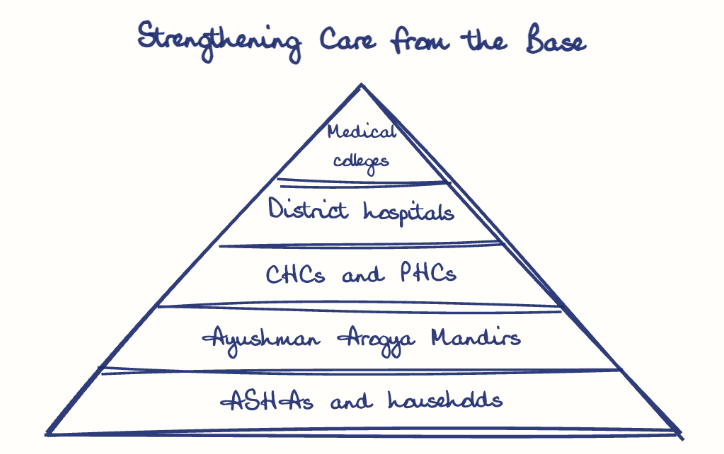
The State must act as provider, payer and regulator to protect citizens from the high costs and distorted priorities of marketised healthcare, chiefly by strengthening a free, community-owned primary tier. Out-of-pocket spending was still 39.4% of total health expenditure in 2021-22.
Model answer
Ghissu Editorial · Verified 4 Oct 2026 · 285 words
Catastrophic costs
Out-of-pocket spending was still 39.4% of total health expenditure in 2021-22 (National Health Accounts), pushing families into debt.
Supplier-induced demand
Unnecessary hysterectomies under RSBY in Bihar and Chhattisgarh showed profit overriding clinical need.
Price regulation works
The NPPA's 2017 stent price ceiling and Rajasthan's Right to Health Act 2023 show the State can discipline markets.
Ayushman Arogya Mandirs
Over 1.75 lakh centres, each with a Community Health Officer, should screen for diabetes, hypertension and cancers near home.
Empower ASHAs
Fixed honoraria, social security and a career path would keep these frontline workers motivated.
Free medicines
Pooled procurement on the Tamil Nadu Medical Services Corporation model cuts the largest out-of-pocket cost.
Doorstep and digital care
Makkalai Thedi Maruthuvam and e-Sanjeevani's 43 crore teleconsultations reach remote homes.
Fund primary care
Spend 2.5% of GDP, about 70% on primary care, as the Srinath Reddy HLEG (2011) advised, routed through panchayats.
Regulate private care
Make every State notify the Clinical Establishments Act 2010 with displayed rates.
This model answer is indicative and the model can make mistakes; please verify key facts independently.
Practise this question
1Get the answer sheet
Sized for this question.
2Write your answer
Timed, by hand.
3Get it marked
Your score and what to fix.
This chapter in the exam
Health6 questions
Asked in 5 of 14 sittings since 2013
- 2021"Besides being a moral imperative of a Welfare State, primary health structure is a necessary precondition for sustainable development." Analyze.
- 2020In order to enhance the prospects of social development, sound and adequate health care policies are needed particularly in the fields of geriatric and maternal health care. Discuss.
All 6 questions, sorted by sub-topic, with model answers and practice.
Question from the official UPSC Civil Services (Main) Examination 2024 paper. Answer written by Ghissu's engine and checked against our editorial standards. Found an error? Tell us and we correct it within 48 hours.