2021 · GS Paper 4 · Q10 · 20 marks
The coronavirus disease (COVID-19) pandemic has quickly spread to various countries. As on May 8th, 2020, in India 56342 positive cases of corona had been reported. India with a population of more than 1·35 billion had difficulty in controlling the transmission of coronavirus among its population. Multiple strategies became necessary to handle this outbreak. The Ministry of Health and Family Welfare of India raised awareness about this outbreak and to take all necessary actions to control the spread of COVID-19. Indian Government implemented a 55-day lockdown throughout the country to reduce the transmission of the virus. Schools and colleges had shifted to alternative mode of teaching-learning-evaluation and certification. Online mode became popular during these days. India was not prepared for a sudden onslaught of such a crisis due to limited infrastructure in terms of human resource, money and other facilities needed for taking care of this situation. This disease did not spare anybody irrespective of caste, creed, religion on the one hand and 'have and have not' on the other. Deficiencies in hospital beds, oxygen cylinders, ambulances, hospital staff and crematorium were the most crucial aspects. You are a hospital administrator in a public hospital at the time when coronavirus had attacked large number of people and patients were pouring into hospital day in and day out. (a) What are your criteria and justification for putting your clinical and non-clinical staff to attend to the patients knowing fully well that it is highly infectious disease and resources and infrastructure are limited? (b) If yours is a private hospital, whether your justification and decision would remain same as that of a public hospital?
In short
Staff should be deployed by risk-stratified rostering, skill matching, rotation and with PPE and insurance as preconditions, because a public hospital's duty to patients must be matched by its duty of care to staff. The same holds for a private hospital, since Parmanand Katara (1989) binds every doctor.
Model answer
Ghissu Editorial · Verified 4 Oct 2026 · 273 words
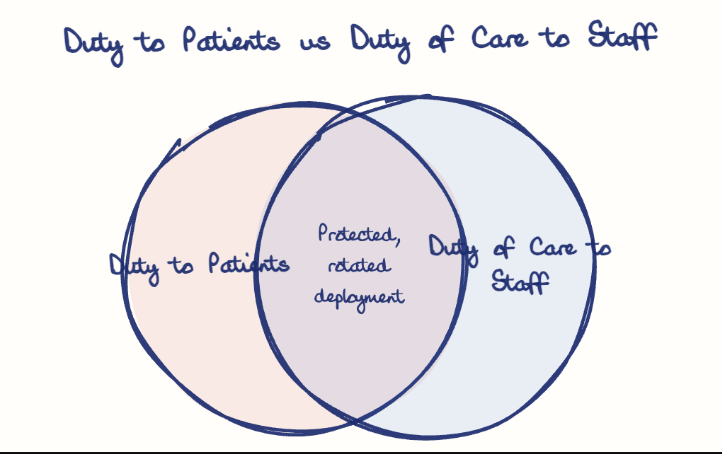
In a pandemic, the administrator must decide whom to send into harm's way. The core dilemma is between Duty to Patients and Duty of Care to Staff, both protected by Article 21.
(a) Criteria for Deploying Clinical and Non-Clinical Staff
1. Risk-stratified rostering: Older, pregnant or comorbid staff take non-COVID roles; fit volunteers go first to COVID wards. 2. Skill and protection: Intensivists and nurses to ICU beds, non-clinical staff trained for triage and logistics, and nobody enters without PPE, testing and the ₹50 lakh PM Garib Kalyan insurance cover [scheme]. 3. Rotation and rest: Fixed shifts, rotation and quarantine stays prevent burnout and Diffusion of Responsibility.
Professional duty
Paschim Banga Khet Mazdoor Samity (1996) [case] held that denial of timely treatment by a government hospital violates Article 21.
Reciprocity
The Epidemic Diseases (Amendment) Act, 2020 [current event] protected health workers in return.
Same core duty
Parmanand Katara (1989) [case] binds every doctor, government or private, to give emergency aid.
Different constraints
Solvency and Fiduciary Duty to owners matter, but the state can step in, as Maharashtra capped rates on 80% of private beds in May 2020; volunteers and hazard pay replace service obligation.
This model answer is indicative and the model can make mistakes; please verify key facts independently.
Practise this question
1Get the answer sheet
Sized for this question.
2Write your answer
Timed, by hand.
3Get it marked
Your score and what to fix.
This chapter in the exam
Social Sector Dilemmas7 questions
Asked in 5 of 14 sittings since 2013
- 2026Lata, a mother of two children, was admitted to a hospital for acute abdominal pain. Her sister-in-law, Sujatha, accompanied her. Dr. Mansi examined Lata and recommended a diagnostic laparoscopy. Lata's consent was taken to conduct the medical procedure under general anesthesia. During the laparoscopy, Dr. Mansi's team discovered a tumor in Lata's uterus. A closer examination suggested that the tumor could be malignant. One option before Dr. Mansi was to extract a sample for biopsy. In that case, if the tumor was malignant, Lata would have to undergo another surgery for removal of the uterus. An alternative was to remove the uterus immediately. Dr. Mansi had to take a quick decision. As Lata was under general anesthesia, Dr. Mansi explained the situation to Sujatha. Sujatha agreed with Dr. Mansi's recommendations for a hysterectomy, wherein Lata's uterus would be removed to avoid the risk and pain of undergoing another surgery. Dr. Mansi removed Lata's uterus after receiving Sujatha's consent in writing. Lata was informed of this the next day. She was very upset and felt betrayed as she had not consented to the removal of her uterus. Lata complained to the police who tried to convince her that Dr. Mansi had acted with good intention to help a patient. Sujatha was of the same opinion, however Lata was not convinced and decided to approach the court. (a) Discuss the ethical issues involved in this case. (b) Discuss the moral conduct of the doctor in this situation.
- 2026Vikas is a government officer with over a decade of service in public administration. He has recently moved as the District Collector (DC) of Nainipura, a remote hilly district bordering a forest. Due to Nainipura's low levels of economic development, one of his major duties is to ensure proper functioning of the public distribution system (PDS) amongst the economically weaker sections (EWS). During his on-site visits, Vikas was apprised of a typical administrative challenge in operating the PDS. To prevent leakages, all distributors were required to carry out real-time biometric identification of the beneficiaries, whose fingerprints were tallied with identity card records. This was creating problems as the operating system sometimes rejected fingerprint matching in the cases of growing children, manual labourers and senior citizens. The problem was further compounded in periods of low WiFi connectivity. The distributors, in such cases, resorted to personal discretion when they could identify the recipient. Vikas had to address this problem on priority. Strictly adhering to government regulations would ensure fiscal probity but would greatly trouble the proposed beneficiary, i.e., EWS. It may even impinge on their fundamental right to life as per Article 21 of the Constitution. Conversely, leaving the resolution solely to the discretion of the distributors could lead to misuse and leakages. (a) What are the options open to Vikas? How should he balance fiscal probity with empathy towards the designated beneficiaries? (b) Discuss the ethics of using technology as a gatekeeper for welfare schemes.
All 7 questions, sorted by sub-topic, with model answers and practice.
Question from the official UPSC Civil Services (Main) Examination 2021 paper. Answer written by Ghissu's engine and checked against our editorial standards. Found an error? Tell us and we correct it within 48 hours.