2022 · GS Paper 3 · Q1 · 10 marks
Why is Public Private Partnership (PPP) required in infrastructural projects ? Examine the role of PPP model in the redevelopment of Railway Stations in India.
In short
PPP is needed because India's infrastructure need, about ₹111 lakh crore under the National Infrastructure Pipeline, exceeds public budgets, and it brings efficiency and risk sharing. In stations it works through land value capture, as at Rani Kamlapati (Habibganj), but weak bids have pushed Railways towards a budget-led hybrid model.
Model answer
Ghissu Editorial · Verified 4 Oct 2026 · 299 words
Fiscal headroom
Private equity and debt stretch public capex, whose infrastructure multiplier is 2.5 to 3.5 times (Economic Survey 2025-26).
Life-cycle efficiency
Performance-linked concessions reward timely construction and upkeep, as in the Delhi and Mumbai airports after 2006.
Risk sharing
Construction and operating risks move to private partners, while the Hybrid Annuity Model (2016) keeps traffic risk with the state.
Land value capture
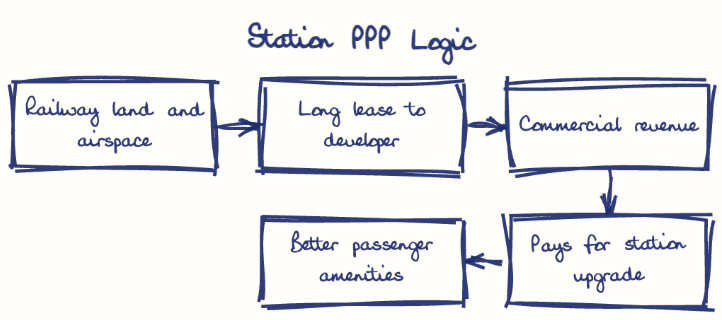
The Rail Land Development Authority leases surplus land and airspace so that commercial returns fund passenger facilities.
Early proofs
Rani Kamlapati (Habibganj) station in Bhopal, redeveloped by the Bansal Group in 2021, was India's first PPP station, and Gandhinagar Capital station carries a hotel above its tracks.
Limits exposed
Weak bids in the 2017 Swiss-challenge round, owing to long paybacks and real-estate risk, pushed New Delhi, Ahmedabad and CSMT redevelopment (2022) to budget-funded EPC.
Hybrid model now
The Amrit Bharat Station Scheme (103 stations inaugurated in May 2025) funds core works publicly, while private capital enters through retail, hotels and the 400 stations in the National Monetisation Pipeline.
This model answer is indicative and the model can make mistakes; please verify key facts independently.
Practise this question
1Get the answer sheet
Sized for this question.
2Write your answer
Timed, by hand.
3Get it marked
Your score and what to fix.
This chapter in the exam
Investment Models4 questions
Asked in 4 of 14 sittings since 2013
- 2020Explain the meaning of investment in an economy in terms of capital formation. Discuss the factors to be considered while designing a concession agreement between a public entity and a private entity.
- 2014Explain how Private Public Partnership arrangements, in long gestation infrastructure projects, can transfer unsustainable liabilities to the future. What arrangements need to be put in place to ensure that successive generations' capacities are not compromised?
All 4 questions, sorted by sub-topic, with model answers and practice.
Question from the official UPSC Civil Services (Main) Examination 2022 paper. Answer written by Ghissu's engine and checked against our editorial standards. Found an error? Tell us and we correct it within 48 hours.