2022 · GS Paper 4 · Q4(b) · 10 marks
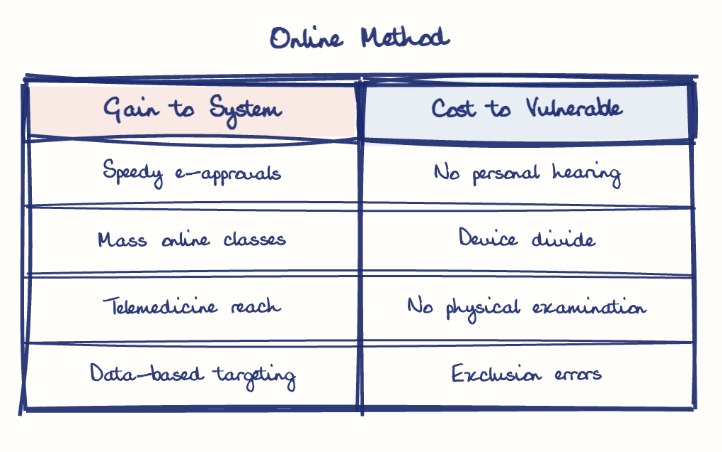
Online methodology is being used for day-to-day meetings, institutional approvals in the administration and for teaching and learning in education sector to the extent telemedicine in the health sector is getting popular with the approvals of the competent authority. No doubt, it has advantages and disadvantages for both the beneficiaries and the system at large. Describe and discuss the ethical issues involved in the use of online method particularly to the vulnerable section of the society.
In short
Online methods raise ethical issues of equity, exclusion, consent, privacy and dignity for vulnerable groups because they assume a connected, literate and able user. The death of Santoshi Kumari in Jharkhand in 2017, after her ration was cut for want of Aadhaar seeding, shows the human cost.
Model answer
Ghissu Editorial · Verified 4 Oct 2026 · 289 words
Real benefits
The Telemedicine Practice Guidelines (2020) brought specialists to distant villages, and e-Office trails cut delay and discretion in approvals.
A hidden filter
The NSS 75th round (2017-18) found only about 24% of households had internet access, so going online shifts the burden onto the poorest.
Justice and equity
In June 2020 a Dalit schoolgirl in Malappuram, Kerala died by suicide after she could not attend online classes, a digital divide turned into a denial of education.
Exclusion from entitlements
Santoshi Kumari of Simdega, Jharkhand died of hunger in 2017 after her family's ration was cut for want of Aadhaar seeding.
Autonomy and privacy
Elderly and child users rarely give informed consent; NCRB recorded a 32% rise in cyber-crimes against children between 2021 and 2022.
Dignity and care
Remote care loses the physical examination, and *Amar Jain v. Union of India* (2025) held digital access to be part of Article 21.
This model answer is indicative and the model can make mistakes; please verify key facts independently.
Practise this question
1Get the answer sheet
Sized for this question.
2Write your answer
Timed, by hand.
3Get it marked
Your score and what to fix.
This chapter in the exam
Dimensions of ethics13 questions
Asked in 8 of 14 sittings since 2013
- 2026Citing the serious adverse effects of long-term medication, a doctor convinces the family of a female patient for surgery. This led the patient to reluctantly consent for the surgery, though her original choice was to opt for medication. Explain the concepts of paternalism and beneficence by analysing the doctor's action.
- 2026Some moral philosophers argue that spending some of your resources—without significantly affecting your financial stability—to help other people who badly suffer is our moral duty and not merely a matter of charity. Justify this claim by explaining the distinction between duty and charity.
All 13 questions, sorted by sub-topic, with model answers and practice.
Question from the official UPSC Civil Services (Main) Examination 2022 paper. Answer written by Ghissu's engine and checked against our editorial standards. Found an error? Tell us and we correct it within 48 hours.