2023 · GS Paper 1 · Q19 · 15 marks
Why is caste identity in India both fluid and static?
In short
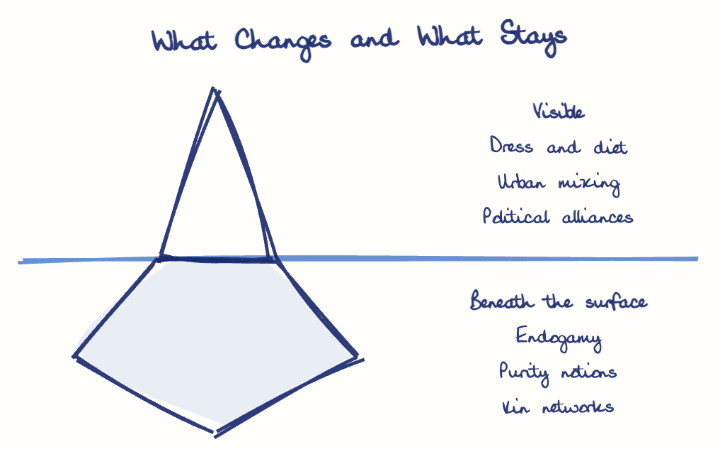
Caste identity is fluid because Sanskritisation, political mobilisation and changing legal categories keep reshaping a caste's rank, but static because endogamy, purity notions and violence keep its boundary of birth intact. Only about 5% of Indian marriages crossed caste lines in IHDS-II (2011-12).
Model answer
Ghissu Editorial · Verified 4 Oct 2026 · 272 words
Sanskritisation
Srinivas showed lower castes raising status by adopting upper-caste rituals and diet, while education and urban jobs offered modern routes.
Political mobilisation
Universal franchise turned castes into interest groups, and after Mandal (1990) OBC parties reshaped power in Uttar Pradesh and Bihar.
Changing categories
Marathas, Jats and Patidars sought backward status, and Davinder Singh (2024) allowed sub-classification of Scheduled Castes.
Exit and redefinition
Ambedkar's 1956 conversion to Buddhism and Dipankar Gupta's horizontal identities show caste being reimagined.
Atrocity and violence
NCRB recorded over 57,000 crimes against Scheduled Castes in 2022, showing that Dalit assertion still meets coercion.
Occupational stigma
Sewer and septic-tank deaths still fall mostly on Dalit workers, prompting the NAMASTE scheme (2023) to mechanise the work.
Old boundaries renewed
Caste filters on matrimonial apps reproduce endogamy, and Census 2027 will enumerate caste for the first time since 1931.
Integrate and enforce
Expand inter-caste marriage incentives, protect couples as Shakti Vahini (2018) directed, and fast-track Atrocities Act courts.
This model answer is indicative and the model can make mistakes; please verify key facts independently.
Practise this question
1Get the answer sheet
Sized for this question.
2Write your answer
Timed, by hand.
3Get it marked
Your score and what to fix.
This chapter in the exam
Salient features of Indian Society, Diversity of India23 questions
Asked in 13 of 14 sittings since 2013
- 2026Unity in diversity remains the defining feature of Indian society despite the challenges from communalism and regionalism. Comment.
- 2026Is caste disappearing in urban India? Illustrate your answer with examples.
All 23 questions, sorted by sub-topic, with model answers and practice.
Question from the official UPSC Civil Services (Main) Examination 2023 paper. Answer written by Ghissu's engine and checked against our editorial standards. Found an error? Tell us and we correct it within 48 hours.