2023 · GS Paper 2 · Q1 · 10 marks
Constitutionally guaranteed judicial independence is a prerequisite of democracy. Comment.
In short
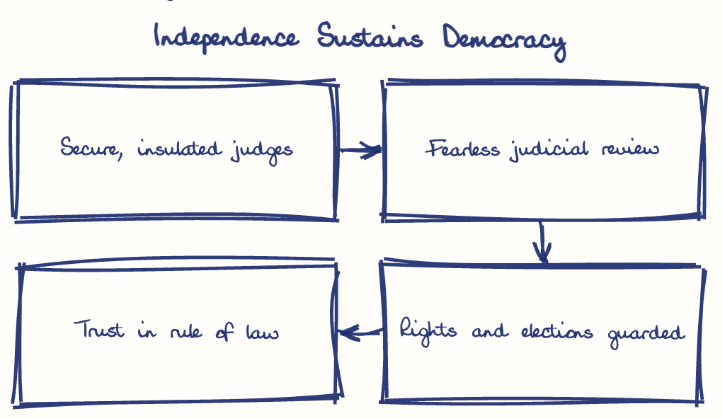
Constitutional guarantees of tenure, salary and insulation let the judiciary restrain elected majorities, which makes its independence a precondition of democracy. Kesavananda Bharati (1973) and Indira Gandhi v. Raj Narain (1975) show independent courts protecting the basic structure and free elections.
Model answer
Ghissu Editorial · Verified 4 Oct 2026 · 270 words
Tenure and salary
Judges are removable only on proved misbehaviour or incapacity by a special-majority address of Parliament (Article 124(4)), and salaries are charged on the Consolidated Fund and protected from cuts after appointment (Articles 112 and 125).
Insulation
Legislatures cannot discuss judges' conduct (Articles 121 and 211), contempt power (Article 129) protects authority, Article 50 separates the judiciary from the executive, and retired judges cannot practise (Article 124(7)).
Limits on majorities
Kesavananda Bharati (1973) and Minerva Mills (1980) kept even Parliament's amending power within the basic structure.
Guarding elections
Indira Gandhi v. Raj Narain (1975) struck down the 39th Amendment clause shielding the Prime Minister's election from judicial scrutiny.
Cost of deference
A deferential Court in ADM Jabalpur (1976) let habeas corpus be suspended during the Emergency, a wrong Puttaswamy (2017) expressly overruled.
Accountability too
Opaque collegium appointments, post-retirement posts and 5.29 crore pending cases (Law Ministry, July 2025) erode trust, so independence must come with transparency.
This model answer is indicative and the model can make mistakes; please verify key facts independently.
Practise this question
1Get the answer sheet
Sized for this question.
2Write your answer
Timed, by hand.
3Get it marked
Your score and what to fix.
This chapter in the exam
Structure, Organization and Functioning of the Union Judiciary7 questions
Asked in 7 of 14 sittings since 2013
- 2026What is meant by judicial legislation ? In this context, discuss the verdicts of the apex court allowing “passive euthanasia” and a “living will”.
- 2024Explain the reasons for the growth of public interest litigation in India. As a result of it, has the Indian Supreme Court emerged as the world's most powerful judiciary?
All 7 questions, sorted by sub-topic, with model answers and practice.
Question from the official UPSC Civil Services (Main) Examination 2023 paper. Answer written by Ghissu's engine and checked against our editorial standards. Found an error? Tell us and we correct it within 48 hours.