2023 · GS Paper 2 · Q3 · 10 marks
The states in India seem reluctant to empower urban local bodies both functionally as well as financially. Comment.
In short
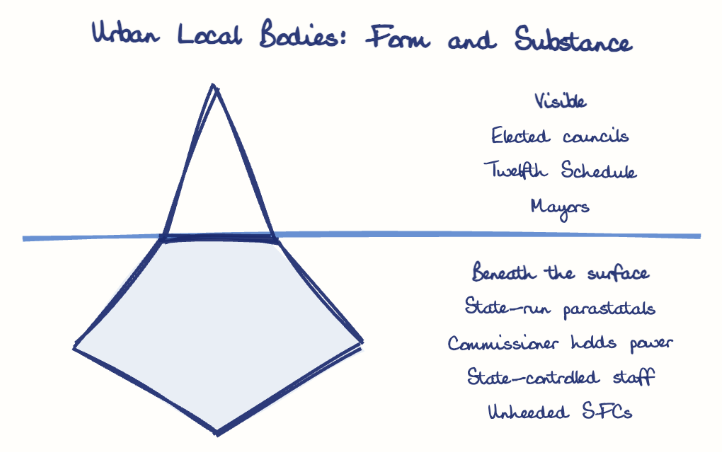
States have largely created elected urban local bodies in form while retaining functions, staff and taxes, keeping municipalities dependent on them. Municipal own-source revenue was only 0.38% of GDP in 2021-22, as states control property tax rates and parastatals run key services.
Model answer
Ghissu Editorial · Verified 4 Oct 2026 · 292 words
Parastatals
Water, planning and transport sit with state boards and development authorities, such as Bengaluru's water supply board, leaving corporations to maintain what others build.
Weak mayors
Mayors in many states are indirectly elected with short terms, Delhi's for one year, while the state-appointed commissioner holds executive power.
Borrowed staff
Recruitment, transfers and supersession remain state decisions, so councils cannot build capacity.
Planning withheld
Metropolitan Planning Committees under Article 243ZE exist in only a few cities, so state authorities still draft master plans.
Thin own revenue
Municipal own-source revenue was only 0.38% of GDP in 2021-22 (Janaagraha), because states fix property tax rates and rarely revise them.
Taxes taken away
The 101st Amendment (2016) folded octroi and entry tax into GST without a municipal share.
Neglected SFCs
The IIPA study for the 16th Finance Commission (2025) found that Punjab, for its second SFC, was the only state to table an Action Taken Report within six months.
The exceptions
Kerala devolved funds and staff, and Ahmedabad issued India's first municipal bond without a state guarantee in 1998, showing what empowered cities achieve.
This model answer is indicative and the model can make mistakes; please verify key facts independently.
Practise this question
1Get the answer sheet
Sized for this question.
2Write your answer
Timed, by hand.
3Get it marked
Your score and what to fix.
This chapter in the exam
Devolution — Municipalities2 questions
Asked in 2 of 14 sittings since 2013
Question from the official UPSC Civil Services (Main) Examination 2023 paper. Answer written by Ghissu's engine and checked against our editorial standards. Found an error? Tell us and we correct it within 48 hours.