2023 · GS Paper 4 · Q2(b) · 10 marks
In the context of work environment, differentiate between 'coercion' and 'undue influence' with suitable examples.
In short
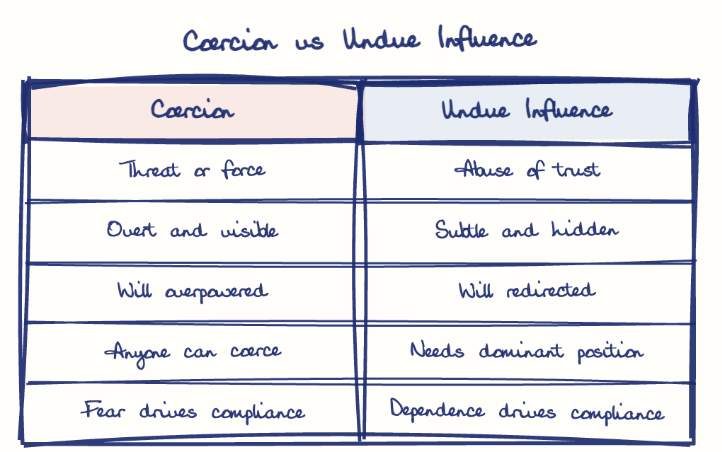
Coercion compels an employee through threats or force, while undue influence bends his judgment by exploiting a position of trust or dominance. A threat of dismissal for refusing to sign a backdated report is coercion; a mentor-superior steering a dependent probationer towards his favoured vendor is undue influence.
Model answer
Ghissu Editorial · Verified 4 Oct 2026 · 303 words
Coercion overpowers the will
A manager who threatens an adverse appraisal or dismissal unless a junior signs a backdated inspection report leaves no real choice.
Undue influence exploits dependence
A reporting officer who controls a probationer's confirmation "suggests" she clear a vendor he favours; there is no threat, yet her judgment bends.
Different visibility
Coercion leaves evidence such as messages and witnesses, while undue influence hides behind courtesy and is harder to prove.
Same ethical wrong
Both treat the employee as a means, violating Kant's respect for persons, and yield only outward compliance.
Quid pro quo harassment
The Sexual Harassment of Women at Workplace Act, 2013 treats a threat about a woman's employment status as harassment, coercion in its plainest form.
Pressure on officers
A transfer threat for refusing an illegal order is coercion; a minister's hint of a prized posting for a favourable noting is undue influence.
Safeguards
The CCS (Conduct) Rules, 1964 require oral directions to be confirmed in writing, and Internal Committees under the 2013 Act give victims a remedy.
This model answer is indicative and the model can make mistakes; please verify key facts independently.
Practise this question
1Get the answer sheet
Sized for this question.
2Write your answer
Timed, by hand.
3Get it marked
Your score and what to fix.
This chapter in the exam
Social influence and persuasion2 questions
Asked in 2 of 14 sittings since 2013
Question from the official UPSC Civil Services (Main) Examination 2023 paper. Answer written by Ghissu's engine and checked against our editorial standards. Found an error? Tell us and we correct it within 48 hours.