2024 · GS Paper 1 · Q18 · 15 marks
Despite comprehensive policies for equity and social justice, underprivileged sections are not yet getting the full benefits of affirmative action envisaged by the Constitution. Comment.
In short
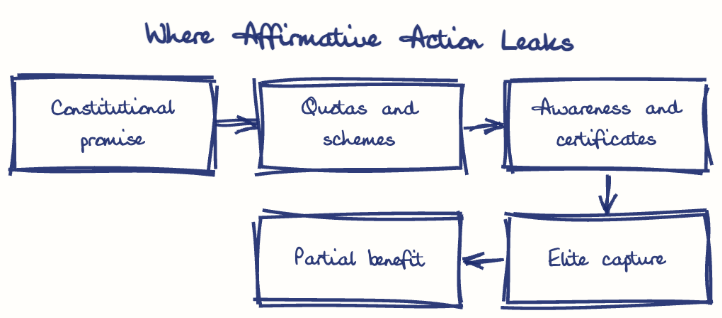
Affirmative action has built a floor of representation for Dalits, Adivasis and backward classes, but elite capture, shrinking public jobs and prejudice keep the poorest from its full benefit. The Rohini Commission found about 97% of central OBC benefits going to roughly a quarter of OBC castes.
Model answer
Ghissu Editorial · Verified 4 Oct 2026 · 289 words
Constitutional mandate
Articles 15(4), 15(5) and 16(4) enable quotas in education and jobs, Articles 330 and 332 reserve seats, and the 103rd Amendment (2019) added the EWS quota.
Laws and watchdogs
The Atrocities Act, 1989 is monitored by the National Commissions under Articles 338, 338A and 338B, while scholarships and Stand-Up India (2016) have helped a Dalit middle class emerge.
Elite capture
The Rohini Commission found about 97% of central OBC benefits going to roughly a quarter of OBC castes, with 983 communities getting none; Davinder Singh (2024) allowed sub-classification of SCs.
Shrinking opportunity
Public jobs are a small share of employment, contractualisation narrows them, and the private sector has no quota.
Access and prejudice
Certificate hurdles keep Musahars and PVTGs out, while the Rohith Vemula (2016) and Payal Tadvi (2019) cases expose caste bias on campus.
Targeted equity
Use Census 2027 caste data to sub-categorise quotas, extend supplier diversity such as the 4% procurement share for SC/ST enterprises, and enforce the Atrocities Act through Special Courts.
This model answer is indicative and the model can make mistakes; please verify key facts independently.
Practise this question
1Get the answer sheet
Sized for this question.
2Write your answer
Timed, by hand.
3Get it marked
Your score and what to fix.
This chapter in the exam
Social empowerment7 questions
Asked in 6 of 14 sittings since 2013
- 2026How do you understand disability? Substantiate the need for inclusive policy framework in India in this regard.
- 2026Do you think digital technology promotes social empowerment? Explain with examples.
All 7 questions, sorted by sub-topic, with model answers and practice.
Question from the official UPSC Civil Services (Main) Examination 2024 paper. Answer written by Ghissu's engine and checked against our editorial standards. Found an error? Tell us and we correct it within 48 hours.