2026 · GS Paper 1 · Q9 · 10 marks
How do you understand disability? Substantiate the need for inclusive policy framework in India in this regard.
In short
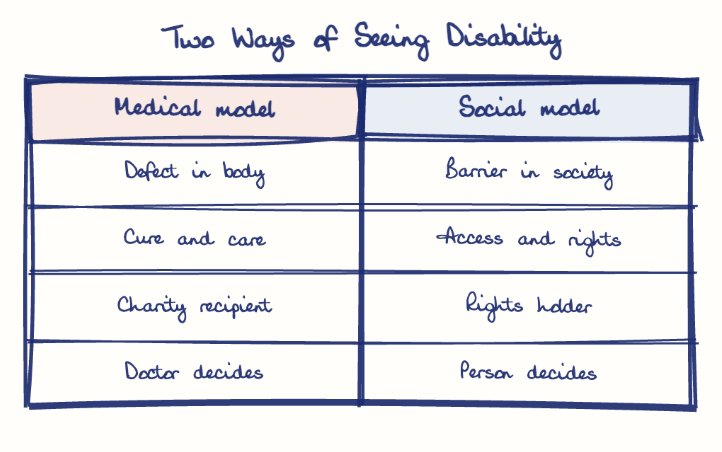
Disability is best understood as an impairment meeting social and environmental barriers, not a defect to be cured, which is why India needs inclusive, rights-based policy. In Rajive Raturi v Union of India (2024), the Supreme Court found accessibility rules merely advisory and ordered mandatory standards.
Model answer
Ghissu Editorial · Verified 4 Oct 2026 · 291 words
Rights-based shift
The UNCRPD (2006), ratified by India in 2007, sees disability as impairment meeting attitudinal and environmental barriers.
Statutory meaning
The RPwD Act, 2016 widens recognised conditions from 7 to 21, including autism and acid attack, with 40% as benchmark disability and a 4% job quota.
Intersectionality
Gender, caste and poverty stack exclusion on a rural woman with a disability, shutting her out of school, work and marriage.
Accessibility deficit
Rajive Raturi v Union of India (2024) held that the 2017 accessibility rules were merely advisory and ordered mandatory standards, nine years after the Accessible India Campaign (2015).
Work and education
The 4% job and 5% higher-education quotas often go unfilled, and ableist hiring pushes many into informal work.
Accommodation and dignity
Vikash Kumar v UPSC (2021) extended scribes beyond benchmark disability, Jeeja Ghosh (2016) exposed indignity in air travel, and India's 29 medals at the Paris 2024 Paralympics show what support achieves.
This model answer is indicative and the model can make mistakes; please verify key facts independently.
Practise this question
1Get the answer sheet
Sized for this question.
2Write your answer
Timed, by hand.
3Get it marked
Your score and what to fix.
This chapter in the exam
Social empowerment7 questions
Asked in 6 of 14 sittings since 2013
- 2026Do you think digital technology promotes social empowerment? Explain with examples.
- 2025Does tribal development in India centre around two axes, those of displacement and of rehabilitation ? Give your opinion.
All 7 questions, sorted by sub-topic, with model answers and practice.
Question from the official UPSC Civil Services (Main) Examination 2026 paper. Answer written by Ghissu's engine and checked against our editorial standards. Found an error? Tell us and we correct it within 48 hours.