2024 · GS Paper 1 · Q12 · 15 marks
How far is it correct to say that the First World War was fought essentially for the preservation of balance of power?
In short
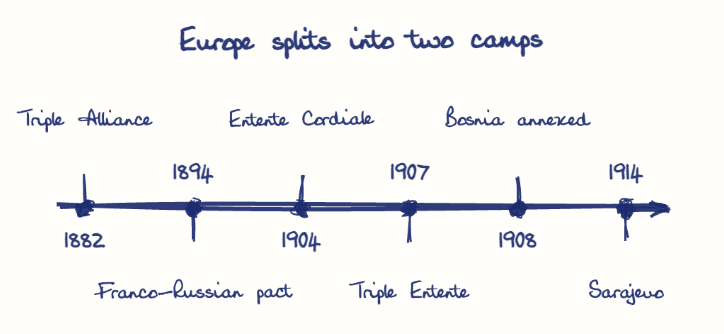
The claim is only partly correct: balance-of-power alliances explain how the Sarajevo crisis became a general war, but hegemony, nationalism and imperial rivalry drove it. Fritz Fischer read Germany's September Programme of 1914 as a bid to dominate Europe, which overturns a balance.
Model answer
Ghissu Editorial · Verified 4 Oct 2026 · 290 words
Britain's motive
Britain entered to stop German mastery of the continent and the Channel coast, with Belgium's invasion as the trigger.
Russia and Austria
Russia backed Serbia to stop Austrian dominance of the Balkans, while Vienna saw crushing Serbia as the key to its great-power survival.
German encirclement fear
Facing France and a rearming Russia, Berlin judged war in 1914 better than war later.
Hegemony, not balance
Fritz Fischer read Germany's September Programme (1914) as a bid for domination of Europe.
Nationalism
Serbian irredentism and French revanche for Alsace-Lorraine stirred the masses more than equilibrium did.
Imperial rivalry
The Moroccan crises (1905, 1911) and the naval race reflected a contest for colonies, Lenin's "imperialist war".
Militarism and opportunism
Mobilisation timetables drove events, and Italy (1915) and the US (1917) joined for territory and over submarine warfare.
Lesson
Balance needs crisis diplomacy, which is why the League and the UN sought collective security over rigid blocs.
This model answer is indicative and the model can make mistakes; please verify key facts independently.
Practise this question
1Get the answer sheet
Sized for this question.
2Write your answer
Timed, by hand.
3Get it marked
Your score and what to fix.
This chapter in the exam
World Wars4 questions
Asked in 4 of 14 sittings since 2013
- 2021“There arose a serious challenge to the Democratic State System between the two World Wars.” Evaluate the statement.
- 2015To what extent can Germany be held responsible for causing the two World Wars? Discuss critically.
All 4 questions, sorted by sub-topic, with model answers and practice.
Question from the official UPSC Civil Services (Main) Examination 2024 paper. Answer written by Ghissu's engine and checked against our editorial standards. Found an error? Tell us and we correct it within 48 hours.