2024 · GS Paper 1 · Q16 · 15 marks
What is a twister? Why are the majority of twisters observed in areas around the Gulf of Mexico?
In short
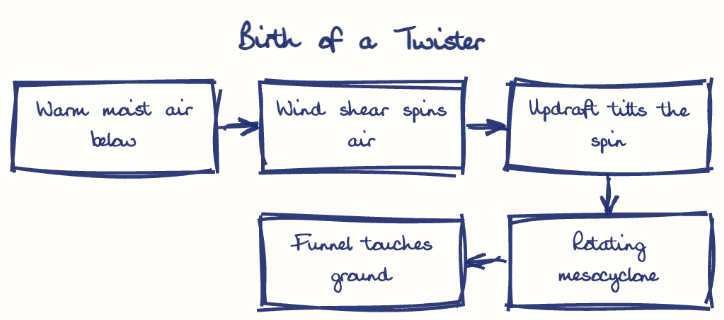
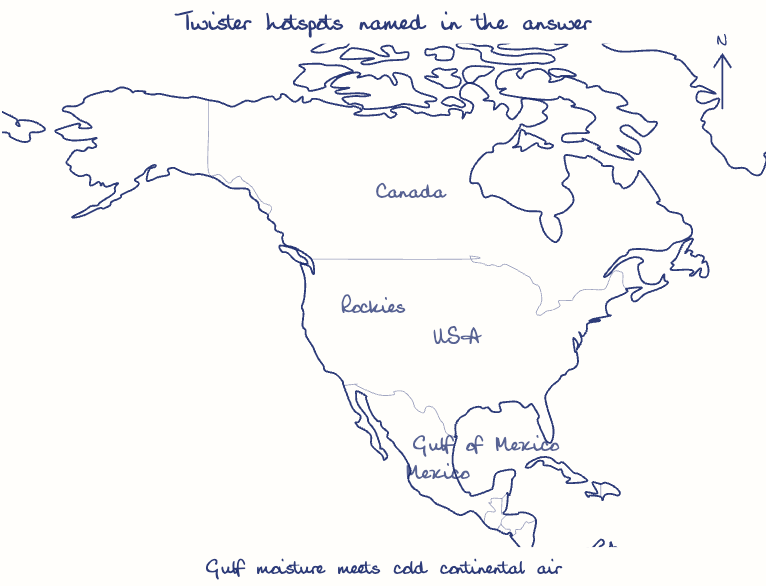
A twister is a violently rotating column of air from a thundercloud to the ground, and most form near the Gulf of Mexico because its warm moist air clashes with cold, dry continental air over the barrier-free Great Plains. The United States records more than 1,000 tornadoes a year.
Model answer
Ghissu Editorial · Verified 4 Oct 2026 · 290 words
Small but violent
Usually a few hundred metres wide and lasting minutes, it can carry winds above 400 km/h, rated on the Enhanced Fujita scale; the EF5 Joplin tornado (2011) killed about 160 people.
Supercell parent
Most strong twisters spin out of supercell thunderstorms with a rotating updraft, unlike a tropical cyclone, which spans hundreds of kilometres over warm seas.
Gulf moisture
A low-level jet carries warm, humid air north from the Gulf in spring, fuelling towering thunderstorms.
Clash of air masses
It meets cold Canadian air and dry Rocky Mountain air along a "dry line", creating extreme instability.
Open plains
North America's mountains run north-south, so the flat Great Plains let air masses collide across Tornado Alley and Dixie Alley.
Jet stream shear
The spring jet stream adds the wind shear that makes storms rotate, as at Rolling Fork, Mississippi (2023).
Warnings and shelters
Doppler radar nowcasting, as in the US NEXRAD network and IMD's growing radar grid, plus storm cellars and wind-resistant codes, save lives.
This model answer is indicative and the model can make mistakes; please verify key facts independently.
Practise this question
1Get the answer sheet
Sized for this question.
2Write your answer
Timed, by hand.
3Get it marked
Your score and what to fix.
This chapter in the exam
Climate12 questions
Asked in 9 of 14 sittings since 2013
- 2026What is the Fujiwara effect? Explain its impact on the movement and intensity of tropical cyclones.
- 2026"Tundra regions are ecologically fragile but economically important." Examine this statement critically.
All 12 questions, sorted by sub-topic, with model answers and practice.
Question from the official UPSC Civil Services (Main) Examination 2024 paper. Answer written by Ghissu's engine and checked against our editorial standards. Found an error? Tell us and we correct it within 48 hours.