2024 · GS Paper 1 · Q5 · 10 marks
Why do large cities tend to attract more migrants than smaller towns? Discuss in the light of conditions in developing countries.
In short
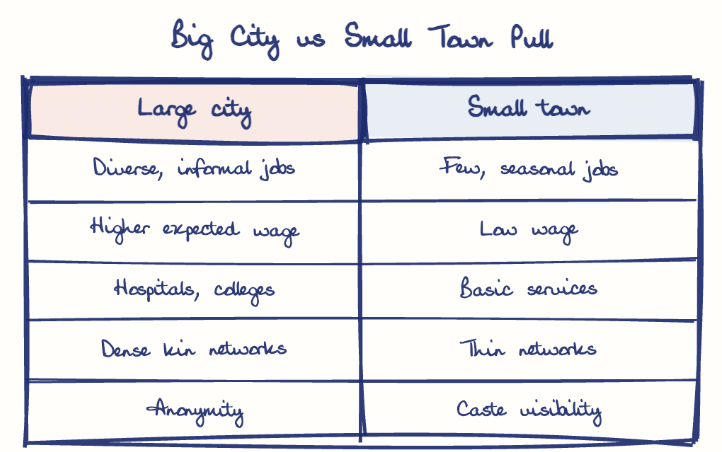
Large cities attract more migrants because agglomeration economies, a large informal sector, concentrated investment, better services and kin networks raise the expected gain from moving, while small towns lack jobs and governance. A 2021 World Bank study found doubling city size raises Indian productivity by about 12%.
Model answer
Ghissu Editorial · Verified 4 Oct 2026 · 297 words
Agglomeration economies
A World Bank study (2021) found that doubling city size raises productivity by about 12% in India, so wages and job variety rise with size.
Expected income
The Harris-Todaro model (1970) explains why migrants come despite unemployment: they weigh the chance of a higher wage, and the informal sector gives a foothold.
Concentrated investment
Michael Lipton's "urban bias" thesis shows states steer infrastructure and industry to big cities, as Dhaka's garment factories drawing rural women show.
Services and mobility
Specialist hospitals, universities and coaching hubs draw families who move for their children's future, not only for work.
Networks and anonymity
Kin chains such as Odisha's Ganjam to Surat's textile mills cut the risk of moving, and Ambedkar saw the village as "a sink of localism", making the city an escape from caste.
Weak small towns
Census towns rose to 3,894 in 2011, yet many lack an urban local body, roads and non-farm jobs to hold migrants.
This model answer is indicative and the model can make mistakes; please verify key facts independently.
Practise this question
1Get the answer sheet
Sized for this question.
2Write your answer
Timed, by hand.
3Get it marked
Your score and what to fix.
This chapter in the exam
World Population and Human Development3 questions
Asked in 2 of 14 sittings since 2013
Question from the official UPSC Civil Services (Main) Examination 2024 paper. Answer written by Ghissu's engine and checked against our editorial standards. Found an error? Tell us and we correct it within 48 hours.