2024 · GS Paper 4 · Q6(a) · 10 marks
"In Indian culture and value system, an equal opportunity has been provided irrespective of gender identity. The number of women in public service has been steadily increasing over the years." Examine the gender-specific challenges faced by female public servants and suggest suitable measures to increase their efficiency in discharging their duties and maintaining high standards of probity.
In short
Women public servants face a glass ceiling, stereotyped postings, unsafe field conditions, a heavier care burden and punitive pressure that strains their probity. Safe workplaces under the POSH Act, 2013, care leave, merit-based postings and fixed tenure under T.S.R. Subramanian (2013) can raise both efficiency and integrity.
Model answer
Ghissu Editorial · Verified 4 Oct 2026 · 290 words
Glass ceiling
The Supreme Court has had only 11 women judges since 1950 (as of 2023) and India has never had a woman Cabinet Secretary, so women rarely shape service norms.
Stereotyped postings
Women are steered to "soft" welfare portfolios rather than revenue, home or finance, narrowing their path to top posts.
Unsafe field conditions
Night duties and remote postings bring harassment, and many offices lack separate toilets and creches.
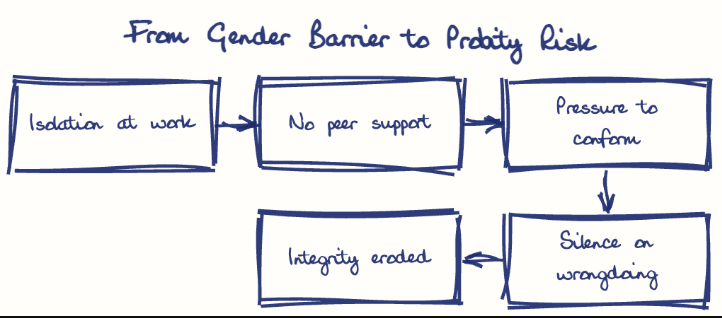
Care burden and integrity pressure
Women spend about 289 minutes a day on unpaid domestic work against 88 for men (Time Use Survey 2024), and upright officers face punitive transfers, as D. Roopa did in 2017.
Safe workplaces
Every office needs a functioning Internal Committee under the POSH Act, 2013, with complaints tracked on the SHe-Box portal.
Care support
The 730 days of Child Care Leave, office creches and spouse-posting norms let women stay in field roles.
Merit-based postings
Gender-neutral rotation and mentoring; Lahaul and Spiti (2023), where women held every top district post, shows the result.
Tenure protection
Civil Services Boards ordered in T.S.R. Subramanian (2013) protect honest officers from retaliatory transfers.
This model answer is indicative and the model can make mistakes; please verify key facts independently.
Practise this question
1Get the answer sheet
Sized for this question.
2Write your answer
Timed, by hand.
3Get it marked
Your score and what to fix.
This chapter in the exam
Probity in Governance — Concept of public service8 questions
Asked in 6 of 14 sittings since 2013
- 2023'Probity is essential for an effective system of governance and socio-economic development.' Discuss.
- 2022Write short notes on the following in 30 words each: Probity in public life
All 8 questions, sorted by sub-topic, with model answers and practice.
Question from the official UPSC Civil Services (Main) Examination 2024 paper. Answer written by Ghissu's engine and checked against our editorial standards. Found an error? Tell us and we correct it within 48 hours.