2024 · GS Paper 4 · Q2(a) · 10 marks
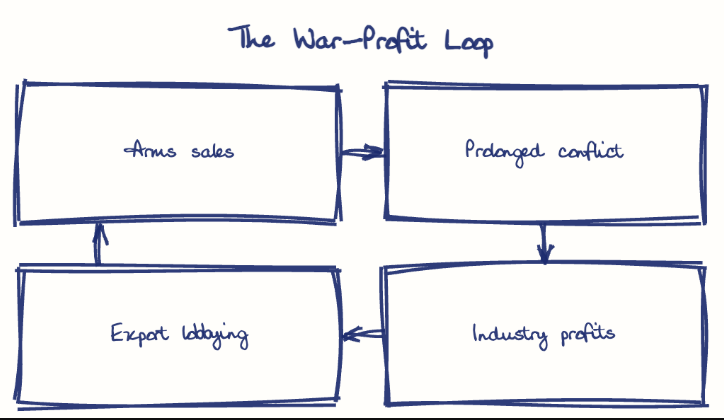
"It is not enough to talk about peace, one must believe in it; and it is not enough to believe in it, one must act upon it." In the present context, the major weapon industries of the developed nations are adversely influencing continuation of number of wars for their own self-interest, all around the world. What are the ethical considerations of the powerful nations in today's international arena to stop continuation of ongoing conflicts?
In short
Powerful nations must put peace above arms-industry profit through restraint in arms transfers, consistent principles, mediation and accountability for war crimes. The United States alone made 43% of global arms exports in 2020-24 (SIPRI, 2025).
Model answer
Ghissu Editorial · Verified 4 Oct 2026 · 291 words
Peace over profit
Profiting from wars one claims to oppose shows conflict of interest blindness; the United States made 43% of global arms exports in 2020-24 (SIPRI, 2025).
Responsibility with power
Most permanent members of the Security Council are major arms exporters, so their Charter duty to keep peace collides with commercial interest and demands restraint.
Consistency
Condemning attacks on civilians in one war while arming the attackers in another reflects compassion asymmetry, a selective empathy.
Restraint in transfers
The Arms Trade Treaty (2014) bars transfers that would be used for war crimes, and powers should honour its spirit even where it is unratified.
Mediation
The United States, Egypt, Qatar and Turkey brokered the Gaza ceasefire of October 2025, echoing India's "this is not an era of war".
Humanitarian access
The UN and Turkey brokered Black Sea Grain Initiative (2022) protected food supplies mid-war.
Accountability
Backing the ICC for allies and rivals alike makes impunity costly.
Peace dividend
Shifting military money to rebuilding addresses the grievances that feed wars, in line with SDG 16.
This model answer is indicative and the model can make mistakes; please verify key facts independently.
Practise this question
1Get the answer sheet
Sized for this question.
2Write your answer
Timed, by hand.
3Get it marked
Your score and what to fix.
This chapter in the exam
Ethical issues in international relations and funding9 questions
Asked in 9 of 14 sittings since 2013
- 2026In international relations, ethical considerations are often subjugated to the strategic interests of nation-states. Discuss this from an ethical perspective.
- 2025Carl von Clausewitz once said, "War is a diplomacy by other means." Critically analyse the above statement in the present context of contemporary geo-political conflict.
All 9 questions, sorted by sub-topic, with model answers and practice.
Question from the official UPSC Civil Services (Main) Examination 2024 paper. Answer written by Ghissu's engine and checked against our editorial standards. Found an error? Tell us and we correct it within 48 hours.