2024 · GS Paper 4 · Q3(a) · 10 marks
What do each of these quotations convey to you in the present context? "Learn everything that is good from others, but bring it in, and in your own way absorb it, do not become others." — Swami Vivekananda
In short
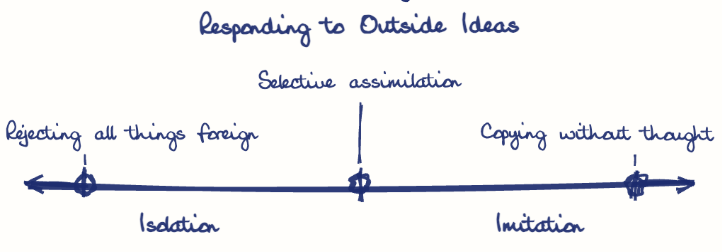
Vivekananda's quotation calls for selective assimilation: learn the good from every source, but adapt it to one's own context instead of imitating others. The Constitution, borrowed from Britain, the US and Ireland yet adapted to Indian conditions, shows the principle at work.
Model answer
Ghissu Editorial · Verified 4 Oct 2026 · 269 words
Openness to learning
Goodness has no nationality, so rejecting a good idea for its origin is prejudice, not pride.
Assimilation, not imitation
Ideas must be fitted to one's own context, as Vivekananda fused Vedanta with organised service in the Ramakrishna Mission (1897), guided by moral autonomy rather than copying. Gandhi agreed: let all cultures blow through my house, but I refuse to be blown off my feet.
Nation-building
The Constitution borrowed from Britain, the US and Ireland, and Ambedkar defended it because each borrowing was adapted to Indian conditions.
Technology and economy
India built UPI on its own design and now runs it in several countries, much as Meiji Japan paired "Japanese spirit" with "Western technique".
Education
NEP 2020 welcomes global universities while promoting mother-tongue teaching and Indian knowledge systems.
Youth and identity
Against the pull of social media to copy lifestyles and opinions wholesale, critical thinking lets the young adopt global good without cultural self-erasure or blind rejection.
This model answer is indicative and the model can make mistakes; please verify key facts independently.
Practise this question
1Get the answer sheet
Sized for this question.
2Write your answer
Timed, by hand.
3Get it marked
Your score and what to fix.
This chapter in the exam
Contributions of moral thinkers and philosophers from India23 questions
Asked in 13 of 14 sittings since 2013
- 2026In what ways can an Indian Administrative Officer apply Gandhi's notion of 'trusteeship' to ensure fairness in governance?
- 2025What do each of these quotations convey to you in the present context? "Those who in trouble untroubled are, Will trouble trouble itself." – Thiruvalluvar
All 23 questions, sorted by sub-topic, with model answers and practice.
Question from the official UPSC Civil Services (Main) Examination 2024 paper. Answer written by Ghissu's engine and checked against our editorial standards. Found an error? Tell us and we correct it within 48 hours.