2025 · GS Paper 1 · Q20 · 15 marks
Does tribal development in India centre around two axes, those of displacement and of rehabilitation ? Give your opinion.
In short
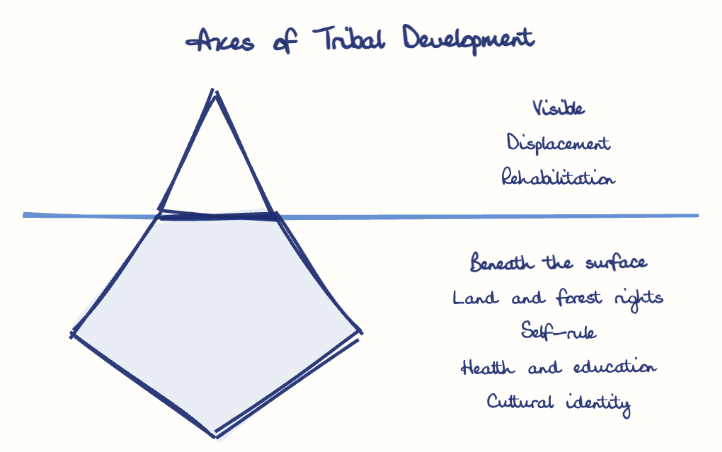
Displacement and rehabilitation are the most visible axis of tribal development, but not its whole: land rights, self-rule, capability and identity matter as much. About 40% of the 60 million people displaced between 1947 and 2004 were Adivasis, per Walter Fernandes.
Model answer
Ghissu Editorial · Verified 4 Oct 2026 · 301 words
Resource geography
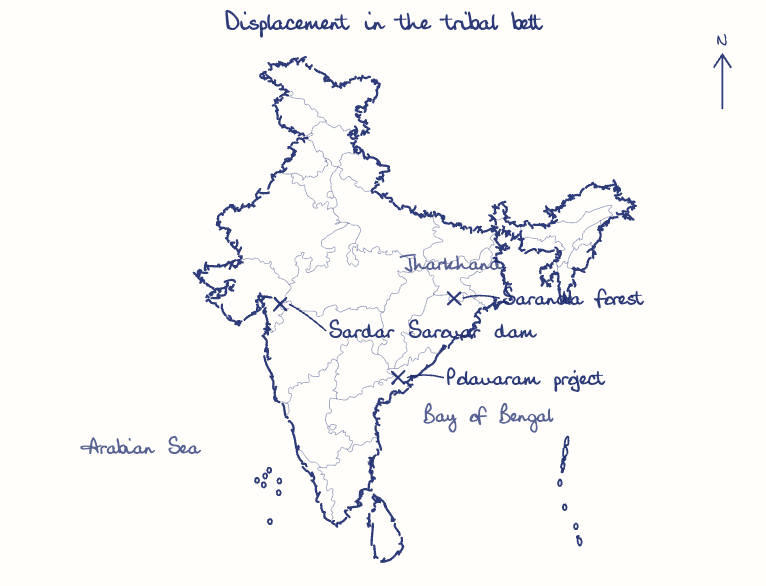
Coal, iron ore and bauxite lie under tribal forests, so Sardar Sarovar, Polavaram and Hasdeo Arand have uprooted Bhil, Koya and Gond communities.
Failed rehabilitation
Michael Cernea's Impoverishment Risks and Reconstruction model shows resettlement breeding landlessness, joblessness and social disarticulation, which cash compensation cannot repair.
Conflict link
The Bandyopadhyay expert group (2008) tied land alienation and displacement to Left-wing extremism in the tribal belt.
Rights over land
The Samatha judgment (1997) voided mining leases of Scheduled Area land, and under the Forest Rights Act, 2006 the Niyamgiri gram sabhas rejected bauxite mining after the 2013 Supreme Court ruling.
Self-governance
PESA, 1996 made the gram sabha custodian of resources, but weak state rules keep self-rule thin.
Capability and identity
The Xaxa Committee (2014) placed education and health deficits beside displacement, PM-JANMAN (2023) targets the 75 PVTGs, and Nehru's Panchsheel made cultural autonomy a goal in itself.
Consent and convergence
Strict use of the RFCTLARR Act, 2013 with prior gram sabha consent, land-for-land rehabilitation and convergence of FRA, PESA and the Dharti Aaba Abhiyan (2024) can make displacement the last resort.
This model answer is indicative and the model can make mistakes; please verify key facts independently.
Practise this question
1Get the answer sheet
Sized for this question.
2Write your answer
Timed, by hand.
3Get it marked
Your score and what to fix.
This chapter in the exam
Social empowerment7 questions
Asked in 6 of 14 sittings since 2013
- 2026How do you understand disability? Substantiate the need for inclusive policy framework in India in this regard.
- 2026Do you think digital technology promotes social empowerment? Explain with examples.
All 7 questions, sorted by sub-topic, with model answers and practice.
Question from the official UPSC Civil Services (Main) Examination 2025 paper. Answer written by Ghissu's engine and checked against our editorial standards. Found an error? Tell us and we correct it within 48 hours.