2025 · GS Paper 2 · Q11 · 15 marks
Constitutional morality is the fulcrum which acts as an essential check upon the high functionaries and citizens alike. In view of the above observation of the Supreme Court, explain the concept of constitutional morality and its application to ensure balance between judicial independence and judicial accountability in India.
In short
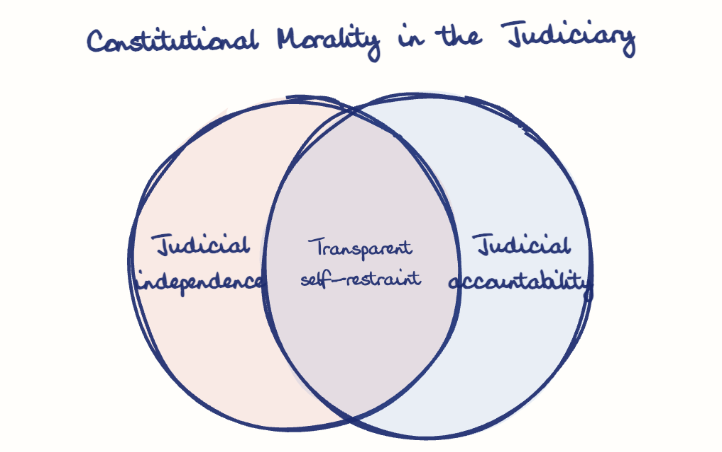
Constitutional morality means fidelity to the Constitution's values and spirit, and it balances the judiciary by treating independence as a means to serve the Constitution and accountability as its condition. The Supreme Court's 2019 Subhash Chandra Agrawal ruling brought the Chief Justice's office under the RTI Act.
Model answer
Ghissu Editorial · Verified 4 Oct 2026 · 268 words
Meaning
Following Grote, Ambedkar told the Constituent Assembly in 1948 that constitutional morality "has to be cultivated": reverence for the Constitution's spirit, not only its letter.
Facets
It rests on the Preamble's ideals, Fundamental Rights, the rule of law and the separation of powers.
Use by courts
Manoj Narula (2014) and NCT of Delhi (2018) used it to restrain high functionaries, and Navtej Singh Johar (2018) to protect individual dignity.
Independence protected
Articles 50, 124(4) and 125 insulate judges, and the 2015 NJAC judgment treated independence as basic structure.
Accountability demanded
Subhash Chandra Agrawal (2019) brought the CJI's office under the RTI Act.
Self-regulation
The 1997 Restatement of Values of Judicial Life and the in-house procedure apply, and in 2025 the Court made public the preliminary report on the cash episode and put judges' assets online.
Rules over goodwill
Finalise the Memorandum of Procedure, create a judge-led statutory complaints body and set a post-retirement cooling-off period.
This model answer is indicative and the model can make mistakes; please verify key facts independently.
Practise this question
1Get the answer sheet
Sized for this question.
2Write your answer
Timed, by hand.
3Get it marked
Your score and what to fix.
This chapter in the exam
Historical Underpinnings, Evolution & Features2 questions
Asked in 2 of 14 sittings since 2013
Question from the official UPSC Civil Services (Main) Examination 2025 paper. Answer written by Ghissu's engine and checked against our editorial standards. Found an error? Tell us and we correct it within 48 hours.