2025 · GS Paper 2 · Q14 · 15 marks
Examine the evolving pattern of Centre-State financial relations in the context of planned development in India. How far have the recent reforms impacted the fiscal federalism in India?
In short
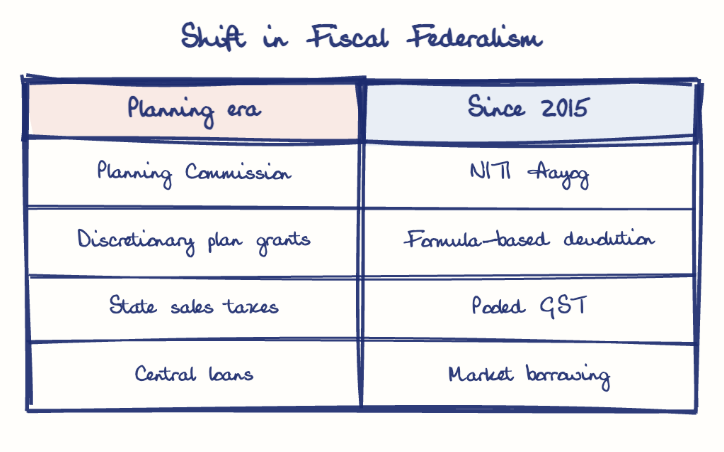
Centre-State financial relations have moved from discretionary Planning Commission grants to formula-based devolution and pooled GST, and recent reforms have strengthened fiscal federalism only partly. Devolution rose to 42% under the Fourteenth Finance Commission, but unshared cesses rose to 20.2% of the Centre's gross tax revenue by 2020-21.
Model answer
Ghissu Editorial · Verified 4 Oct 2026 · 301 words
Plan-era dual channel
Besides Article 280 devolution, the Planning Commission gave discretionary Article 282 grants under the Gadgil formula (1969), a parallel channel bypassing the constitutional body.
Liberalisation and discipline
The 80th Amendment (2000) pooled all central taxes, and debt relief tied to fiscal responsibility laws cut central loans from 15.8% of state liabilities (2005) to 3.5% (2019).
More untied money
The Fourteenth Finance Commission raised devolution to 42%, and the Sixteenth keeps 41% from 2026-27.
Pooled GST
States hold two-thirds of GST Council votes, and Mohit Minerals (2022) made its advice non-binding, but states lost VAT and compensation ended in 2022.
Cesses and curbs
Unshared cesses rose to 20.2% of gross tax revenue by 2020-21 (Union Budget data), and borrowing limits drove Kerala's Article 131 suit (2024).
Share and simplify
Fold excess cesses into the divisible pool and cut Centrally Sponsored Schemes to a flexible core, as the 2015 NITI Aayog sub-group of Chief Ministers urged.
Uniform rules
Apply the Sixteenth Commission's 3% deficit cap and the end of off-budget borrowing to both levels.
This model answer is indicative and the model can make mistakes; please verify key facts independently.
Practise this question
1Get the answer sheet
Sized for this question.
2Write your answer
Timed, by hand.
3Get it marked
Your score and what to fix.
This chapter in the exam
Functions and Responsibilities of the Union and the States7 questions
Asked in 7 of 14 sittings since 2013
- 2026How far has the Indian federal framework been successful in accommodating regional and cultural diversities ? Highlight the role of asymmetric federalism and suggest measures to make dispute resolution mechanisms more effective.
- 2024What changes has the Union Government recently introduced in the domain of Centre-State relations? Suggest measures to be adopted to build the trust between the Centre and the States and for strengthening federalism.
All 7 questions, sorted by sub-topic, with model answers and practice.
Question from the official UPSC Civil Services (Main) Examination 2025 paper. Answer written by Ghissu's engine and checked against our editorial standards. Found an error? Tell us and we correct it within 48 hours.