2026 · GS Paper 2 · Q13 · 15 marks
How far has the Indian federal framework been successful in accommodating regional and cultural diversities ? Highlight the role of asymmetric federalism and suggest measures to make dispute resolution mechanisms more effective.
In short
Indian federalism has largely accommodated regional and cultural diversity through linguistic states, cultural safeguards and asymmetric provisions, though conflicts and Centre-State strains persist. Article 371A's protection of Naga customary law and land shows asymmetry at work, while a permanent water tribunal and an active Inter-State Council would improve dispute resolution.
Model answer
Ghissu Editorial · Verified 4 Oct 2026 · 279 words
Linguistic states
The States Reorganisation Act 1956 and later states like Jharkhand (2000) and Telangana (2014) met regional aspirations within the Union.
Cultural safeguards
Articles 29, 30 and 345 and the Official Languages (Amendment) Act 1967 defused Tamil Nadu's anti-Hindi agitation.
Persisting strains
S.R. Bommai (1994) curbed Article 356 misuse, but J&K's downgrading (2019), delayed assent to state Bills and delimitation fears keep the success incomplete.
Special provisions
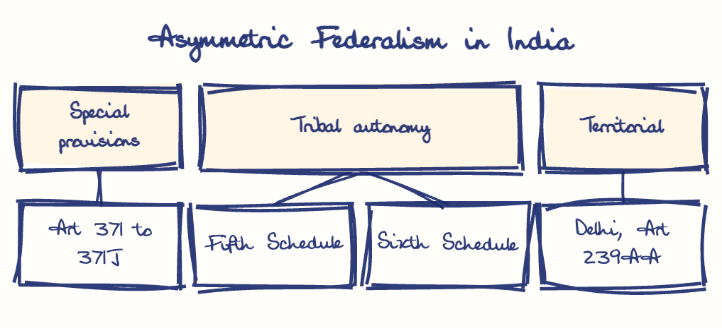
Article 371A protects Naga customary law and land, and Article 371J (2012) gives Kalyana-Karnataka local job reservation.
Peace through asymmetry
The Mizo Accord (1986) traded statehood and Article 371G for an end to insurgency, and the Bodo Accord (2020) strengthened Sixth Schedule self-rule.
Limits
Ladakh's Sixth Schedule agitation shows asymmetry can also breed grievance.
Standing forums
Convene the Inter-State Council regularly, as Punchhi (2010) urged, and use Zonal Councils to extend negotiated boundary deals like the Centre-brokered Assam-Meghalaya agreement (2022).
Faster adjudication
Create a permanent water tribunal in place of ad hoc ones like Cauvery's, and the GST dispute body under Article 279A(11).
This model answer is indicative and the model can make mistakes; please verify key facts independently.
Practise this question
1Get the answer sheet
Sized for this question.
2Write your answer
Timed, by hand.
3Get it marked
Your score and what to fix.
This chapter in the exam
Functions and Responsibilities of the Union and the States7 questions
Asked in 7 of 14 sittings since 2013
- 2025Examine the evolving pattern of Centre-State financial relations in the context of planned development in India. How far have the recent reforms impacted the fiscal federalism in India?
- 2024What changes has the Union Government recently introduced in the domain of Centre-State relations? Suggest measures to be adopted to build the trust between the Centre and the States and for strengthening federalism.
All 7 questions, sorted by sub-topic, with model answers and practice.
Question from the official UPSC Civil Services (Main) Examination 2026 paper. Answer written by Ghissu's engine and checked against our editorial standards. Found an error? Tell us and we correct it within 48 hours.