2025 · GS Paper 2 · Q17 · 15 marks
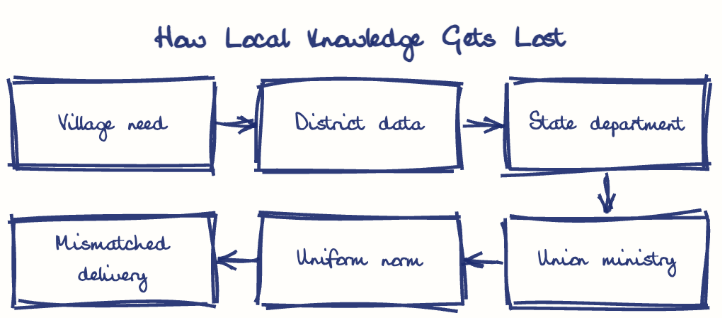
In contemporary development models, decision-making and problem-solving responsibilities are not located close to the source of information and execution defeating the objectives of development. Critically evaluate.
In short
The statement is largely valid, because uniform scheme norms, panchayats without their own revenue and targets set far away have repeatedly defeated development, though national campaigns show the centre still matters. RBI's 2024 study found panchayats' own revenue barely 1.1% of their total revenue.
Model answer
Ghissu Editorial · Verified 4 Oct 2026 · 270 words
Uniform schemes
Centrally sponsored schemes fix unit costs and designs nationally, which is why States' flexi-funds were raised to 25% in 2016 to let them adapt schemes to local terrain.
Funds without autonomy
RBI's 2024 study found panchayats' own revenue barely 1.1% of their revenue, leaving the tier that knows village priorities dependent on tied transfers decided above it.
Ignored local warnings
The M.C. Mishra Committee flagged Joshimath's fragility in 1976, yet distant approvals continued until the town subsided in 2023.
Scale needs the centre
National campaigns eradicated polio (WHO certification, 2014) and ran over 220 crore COVID-19 vaccine doses through CoWIN.
Elite capture
Ambedkar's warning of the village as "a sink of localism" echoes in today's "sarpanch-pati" proxy rule, and many panchayats lack engineers and accountants.
Hybrids work
The Aspirational Districts Programme (2018) pairs national indicators with Collector discretion, and Kerala's People's Plan Campaign (1996) devolved plan funds with clear gains.
This model answer is indicative and the model can make mistakes; please verify key facts independently.
Practise this question
1Get the answer sheet
Sized for this question.
2Write your answer
Timed, by hand.
3Get it marked
Your score and what to fix.
This chapter in the exam
Government Policies — Design & Implementation Issues3 questions
Asked in 3 of 14 sittings since 2013
- 2026Can the constitutional mandate of rights-based welfare be effectively realised in the context of non-integrated governance and minimal public investment ? Examine.
- 2018Policy contradictions among various competing sectors and stakeholders have resulted in inadequate protection and prevention of degradation to environment. Comment with relevant illustrations.
Question from the official UPSC Civil Services (Main) Examination 2025 paper. Answer written by Ghissu's engine and checked against our editorial standards. Found an error? Tell us and we correct it within 48 hours.