2025 · GS Paper 2 · Q5 · 10 marks
The Attorney General of India plays a crucial role in guiding the legal framework of the Union Government and ensuring sound governance through legal counsel. Discuss his responsibilities, rights and limitations in this regard.
In short
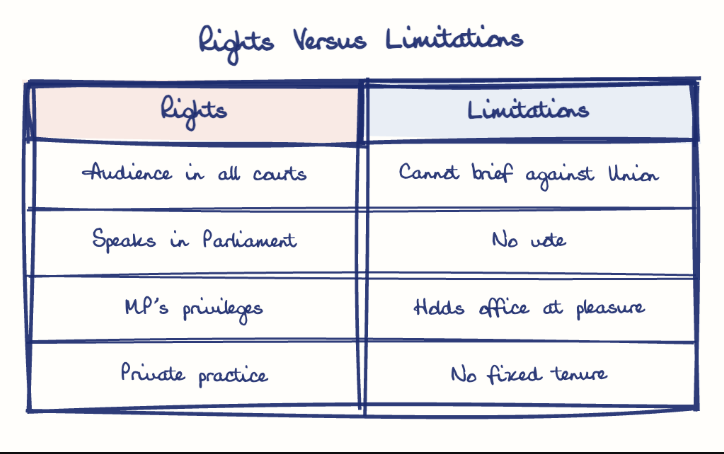
The Attorney General advises the Union on referred legal questions, argues its cases and Article 143 references, and screens private contempt pleas, with audience in all courts and a voice in Parliament. Holding office at the President's pleasure without fixed tenure limits the office's independence.
Model answer
Ghissu Editorial · Verified 4 Oct 2026 · 299 words
Chief legal adviser
Under Article 76(2) the AG advises the Union on legal questions the President refers, testing Bills and executive actions before they are challenged.
Union's advocate
The Law Officers Rules, 1987 require the AG to argue the Union's cases, as in the electoral bonds case (2024), and its view in Article 143 references.
Gatekeeper of contempt
Section 15 of the Contempt of Courts Act, 1971 makes the AG's consent a filter on private criminal contempt pleas, granted against Kunal Kamra in 2020.
Bridge between organs
Articles 76(3), 88 and 105(4) give audience in every court and a voice, without vote, in Parliament.
Independence at risk
With no fixed term, the AG resigns with the government by convention, so candid advice can cost the post.
Advocate or adviser
The 2023 submission that citizens had no right to know political funding sources, rejected by the Court, shows the brief crowding out the Constitution.
This model answer is indicative and the model can make mistakes; please verify key facts independently.
Practise this question
1Get the answer sheet
Sized for this question.
2Write your answer
Timed, by hand.
3Get it marked
Your score and what to fix.
This chapter in the exam
Constitutional Bodies14 questions
Asked in 9 of 14 sittings since 2013
- 2026Is the right to vote a fundamental right ? Discuss the position of the Election Commission of India while undertaking the revision of electoral rolls. Can it also examine the question of citizenship of voters ?
- 2026Do constitutional bodies like the National Commission for Scheduled Castes (NCSC) and the National Commission for Scheduled Tribes (NCST) possess adequate enforcement powers to secure substantive social equality ? Suggest measures to enhance their institutional effectiveness.
All 14 questions, sorted by sub-topic, with model answers and practice.
Question from the official UPSC Civil Services (Main) Examination 2025 paper. Answer written by Ghissu's engine and checked against our editorial standards. Found an error? Tell us and we correct it within 48 hours.