2025 · GS Paper 3 · Q5 · 10 marks
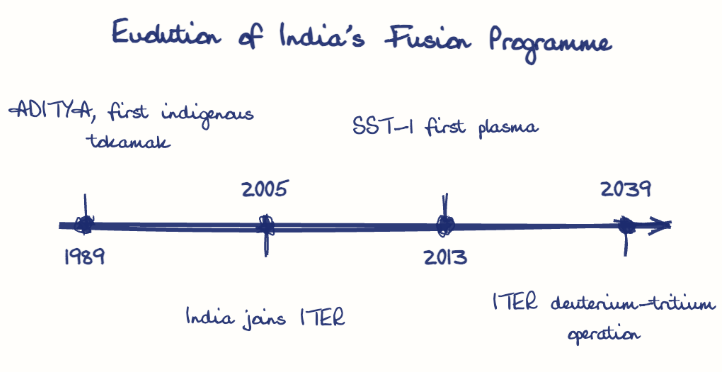
The fusion energy programme in India has steadily evolved over the past few decades. Mention India's contributions to the international fusion energy project – International Thermonuclear Experimental Reactor (ITER). What will be the implications of the success of this project for the future of global energy ?
In short
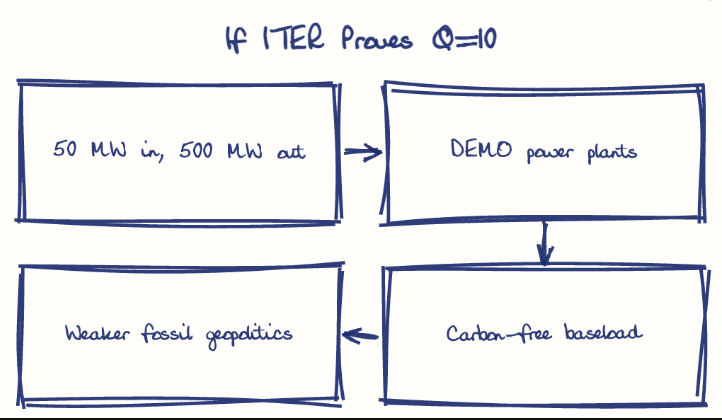
India, building on its ADITYA and SST-1 tokamaks, contributes the cryostat, in-wall shielding, cooling water, cryolines and plasma heating systems to ITER. Success would offer near-limitless, carbon-free baseload power from seawater deuterium and lithium-bred tritium, reshaping global energy geopolitics.
Model answer
Ghissu Editorial · Verified 4 Oct 2026 · 276 words
Cryostat
ITER-India at IPR delivered the cryostat, the world's largest stainless-steel vacuum vessel, built by Larsen and Toubro.
Shielding, cooling and cryogenics
India supplies the in-wall shielding, the cooling water system and the cryolines that keep the magnets cold.
Plasma heating
Ion cyclotron and electron cyclotron heating sources and a diagnostic neutral beam come from India, which bears about 9% of construction value, largely in kind.
Near-limitless fuel
Deuterium from seawater and tritium bred from lithium would end fuel scarcity and import dependence.
Clean and safe power
Fusion emits no carbon dioxide, leaves no long-lived high-level waste and cannot run away like a fission chain reaction.
A new energy order
Abundant baseload for data centres, desalination and green hydrogen would weaken the leverage of fossil-fuel exporters over importers like India.
Realistic caveats
The 2024 baseline pushes deuterium-tritium operation to 2039, and tritium breeding and materials remain unsolved, so fusion complements renewables rather than replacing them soon.
This model answer is indicative and the model can make mistakes; please verify key facts independently.
Practise this question
1Get the answer sheet
Sized for this question.
2Write your answer
Timed, by hand.
3Get it marked
Your score and what to fix.
This chapter in the exam
Developments, Applications and Effects in Everyday Life23 questions
Asked in 13 of 14 sittings since 2013
- 2026Distinguish between a Fast Breeder Reactor (FBR) and a thermal nuclear reactor. In the context of first indigenously developed prototype FBR at Kalpakkam, explain the term 'criticality'. What are its implications for clean energy future of our country? (Answer in 150 words)
- 2025How can India achieve energy independence through clean technology by 2047 ? How can biotechnology play a crucial role in this endeavour ?
All 23 questions, sorted by sub-topic, with model answers and practice.
Question from the official UPSC Civil Services (Main) Examination 2025 paper. Answer written by Ghissu's engine and checked against our editorial standards. Found an error? Tell us and we correct it within 48 hours.