2025 · GS Paper 3 · Q7 · 10 marks
What is Carbon Capture, Utilization and Storage (CCUS) ? What is the potential role of CCUS in tackling climate change ?
In short
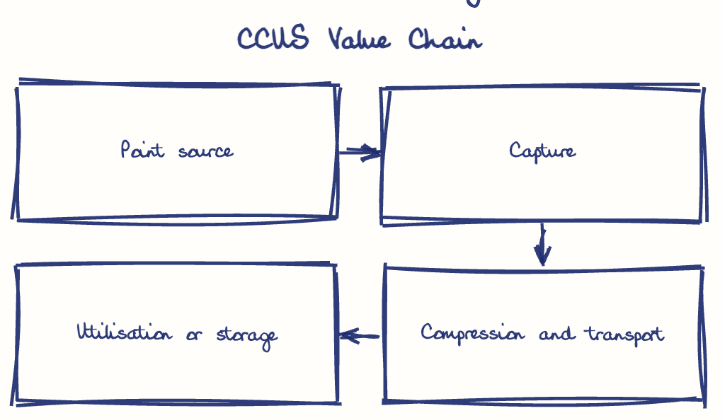
CCUS captures carbon dioxide from large point sources or the air, transports it, and either reuses it in products or stores it permanently in deep geological formations. It matters most for hard-to-abate sectors like cement and steel, which NITI Aayog's 2022 CCUS framework links to India's net zero by 2070.
Model answer
Ghissu Editorial · Verified 4 Oct 2026 · 275 words
Capture and transport
CO2 is separated before or after combustion using solvents such as amines, compressed, and moved by pipeline or ship.
Utilisation
It can become urea, methanol or building materials, as at Tata Steel's 5 tonnes-per-day capture plant at Jamshedpur (2021).
Storage
It is injected into saline aquifers, depleted oil fields or basalt, as Norway's Sleipner project has done since 1996.
Hard-to-abate sectors
Cement, steel and fertiliser release process emissions that renewables cannot remove, so NITI Aayog's CCUS policy framework (2022) sees it as important for net zero by 2070.
Coal lock-in
With energy producing about 76% of India's emissions in 2020 (Fourth Biennial Update Report, 2024), CCUS can clean young coal plants.
Negative emissions
Combined with bioenergy or direct air capture, it can remove CO2, and credits under the Carbon Credit Trading Scheme (2023) can make it pay.
Limits
High cost, energy penalty, leakage risk and fossil fuel lock-in mean it must supplement renewables, not replace them.
This model answer is indicative and the model can make mistakes; please verify key facts independently.
Practise this question
1Get the answer sheet
Sized for this question.
2Write your answer
Timed, by hand.
3Get it marked
Your score and what to fix.
This chapter in the exam
Conservation19 questions
Asked in 11 of 14 sittings since 2013
- 2026Discuss the aim and goals of Kunming-Montreal global biodiversity framework. Mention India's commitments and initiatives to achieve the goals and targets of this framework giving suitable examples. (Answer in 150 words)
- 2025Write a review on India's climate commitments under the Paris Agreement (2015) and mention how these have been further strengthened in COP26 (2021). In this direction, how has the first Nationally Determined Contribution intended by India been updated in 2022 ?
All 19 questions, sorted by sub-topic, with model answers and practice.
Question from the official UPSC Civil Services (Main) Examination 2025 paper. Answer written by Ghissu's engine and checked against our editorial standards. Found an error? Tell us and we correct it within 48 hours.