2025 · GS Paper 4 · Q10 · 20 marks
Rajesh is a Group A officer with nine years of service. He is posted as Administrative Officer in an Oil Public Sector undertaking. As an Administrative Officer he is responsible for managing and coordinating various administrative tasks to ensure smooth functioning of office. He also manages office supplies, equipment etc. Rajesh is now sufficient senior and is expecting his next promotion in JAG (Junior Administrative Grade) in the next one or two years. He knows that promotion is based on examination of ACRs/Performance Appraisal of last few years (5 years or so) of an officer by a DPC (Departmental Promotion Committee) and an officer lacking requisite grading of ACRs may not be found fit for promotion. Consequences of losing promotion may entail financial and reputational loss and set-back for career progression. Though he also puts his best efforts in official discharge of his duties, yet he is unsure of assessment by his superior officer. He is now putting extra efforts so that he gets thumping report at the end of financial year. As Administrative Officer, Rajesh is regularly interacting with his immediate boss, who is his reporting officer for writing his ACR. One day he calls Rajesh and wants him to buy computer-related stationery on priority from a particular vendor. Rajesh instructs his office to initiate action for procuring these items. During the day, the dealing Assistant brings an estimate of Rupees Thirty Five Lakhs covering all stationery items from the same vendor. It is noticed that as per delegated financial powers, as provided in the GFR (General Financial Rules) as applicable in that Organisation, expenditure for office items exceeding Rupees Thirty Lakhs requires sanction of the next higher authority (boss in the present case). Rajesh knows that immediate superior would expect all these purchases should be done at his level and may not appreciate such lack of initiative on his part. During discussions with office, he learns that common practice of splitting of expenditure (where large order is divided into a series of smaller ones) is followed to avoid obtaining sanction from higher authority. This practice is against the rules and may come to the adverse notice of Audit. (a) What are the options available with Rajesh in the above situation? (b) What are the ethical issues involved in this case? (c) Which would be the most appropriate option for Rajesh and why?
In short
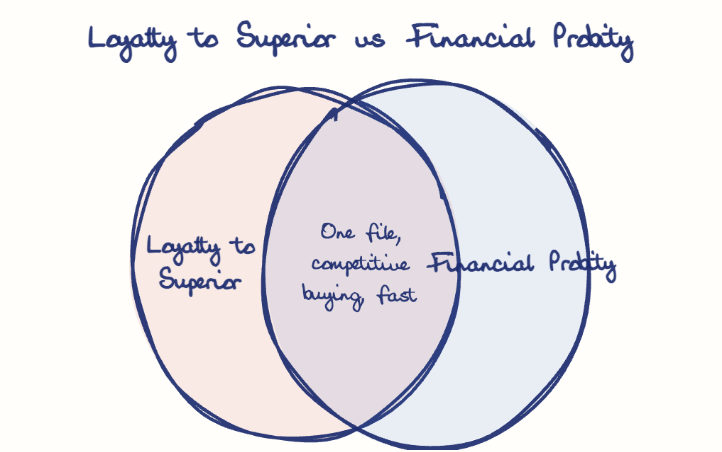
Rajesh should put one consolidated ₹35 lakh proposal to his boss for sanction and buy competitively on priority, rather than split the order to please his reporting officer. GFR 2017 Rule 157 bars splitting a demand to avoid a higher authority's sanction.
Model answer
Ghissu Editorial · Verified 4 Oct 2026 · 293 words
(i) CAPITULATE [Compromised-Hybrid]
Splitting the ₹35 lakh order pleases the boss but breaks the GFR delegation, Conscience Laundering through Hierarchy.
(ii) CONFRONT [Strict-Legal]
Reporting the boss to the CVO at once presumes malafide without proof.
(iii) EVADE [Procedural-Evasive]
Sending the file back to the office is Moral Escapism.
(iv) COMPROMISE [Procedural-Evasive]
Seeking sanction but keeping the nominated vendor leaves favouritism intact.
(v) RECONCILE ✓ [Balanced]
One consolidated file for the boss's sanction, bought competitively and on priority (recommended).
Fraud on delegation
GFR 2017 Rule 157 bars splitting a demand to avoid higher sanction.
Vendor favouritism
A nominated vendor signals a possible Conflict of Interest and bypasses GeM (Rule 149).
ACR as a lever
Career fear breeds Motivated Blindness, and "common practice" normalises the wrong.
Document and disclose
Put the full proposal up citing Rule 157 and confirm oral directions in writing, as T.S.R. Subramanian (2013) [case] advised.
Buy through GeM
GeM [scheme] gives quick, open price discovery in which the vendor can compete.
Contest unfair grading
Dev Dutt (2008) [case] lets him represent against any adverse entry.
This model answer is indicative and the model can make mistakes; please verify key facts independently.
Practise this question
1Get the answer sheet
Sized for this question.
2Write your answer
Timed, by hand.
3Get it marked
Your score and what to fix.
This chapter in the exam
Public Sector and PSU Dilemmas4 questions
Asked in 4 of 14 sittings since 2013
- 2023Vinod is an honest and sincere IAS officer. Recently, he has taken over as Managing Director of the State Road Transport Corporation, his sixth transfer in the past three years. His peers acknowledge his vast knowledge, affability and uprightness. The Chairman of the State Road Transport Corporation is a powerful politician and is very close to the Chief Minister. Vinod comes to know about many alleged irregularities of the Corporation and the high-handedness of the Chairman in financial matters. A Board Member of the Corporation belonging to the Opposition Party meets Vinod and hands over a few documents along with a video recording in which the Chairman appears to be demanding bribe for placing a huge order for the supply of QMR tyres. Vinod recollects the Chairman expediting clearing of pending bills of QMR tyres. Vinod confronts the Board Member as to why he is shying away from exposing the Chairman with the so-called solid proof he has with him. The member informs him that the Chairman refuses to yield to his threats. He adds that Vinod may earn recognition and public support if he himself exposes the Chairman. Further, he tells Vinod that once his party comes to power, Vinod's professional growth would be assured. Vinod is aware that he may be penalized if he exposes the Chairman and may further be transferred to a distant place. He knows that the Opposition Party stands a better chance of coming to power in the forthcoming elections. However, he also realizes that the Board Member is trying to use him for his own political gains. (a) As a conscientious civil servant, evaluate the options available to Vinod. (b) In the light of the above case, comment upon the ethical issues that may arise due to the politicization of bureaucracy.
- 2021An elevated corridor is being constructed to reduce traffic congestion in the capital of a particular state. You have been selected as project manager of this prestigious project on your professional competence and experience. The deadline is to complete the project in next two years by 30 June, 2021, since this project is to be inaugurated by the Chief Minister before the elections are announced in the second week of July 2021. While carrying out the surprise inspection by inspecting team, a minor crack was noticed in one of the piers of the elevated corridor possibly due to poor material used. You immediately informed the chief engineer and stopped further work. It was assessed by you that minimum three piers of the elevated corridor have to be demolished and reconstructed. But this process will delay the project minimum by four to six months. But the chief engineer overruled the observation of inspecting team on the ground that it was a minor crack which will not in any way impact the strength and durability of the bridge. He ordered you to overlook the observation of inspecting team and continue working with same speed and tempo. He informed you that the minister does not want any delay as he wants the Chief Minister to inaugurate the elevated corridor before the elections are declared. Also informed you that the contractor is far relative of the minister and he wants him to finish the project. He also gave you hint that your further promotion as additional chief engineer is under consideration with the ministry. However, you strongly felt that the minor crack in the pier of the elevated corridor will adversely affect the health and life of the bridge and therefore it will be very dangerous not to repair the elevated corridor. (a) Under the given conditions, what are the options available to you as a project manager? (b) What are the ethical dilemmas being faced by the project manager? (c) What are the professional challenges likely to be faced by the project manager and his response to overcome such challenges? (d) What can be the consequences of overlooking the observation raised by the inspecting team?
All 4 questions, sorted by sub-topic, with model answers and practice.
Question from the official UPSC Civil Services (Main) Examination 2025 paper. Answer written by Ghissu's engine and checked against our editorial standards. Found an error? Tell us and we correct it within 48 hours.