2026 · GS Paper 1 · Q14 · 15 marks
Compare the Loo, Chinook and Foehn winds with respect to their regions of prevalence, their nature and climatic impacts.
In short
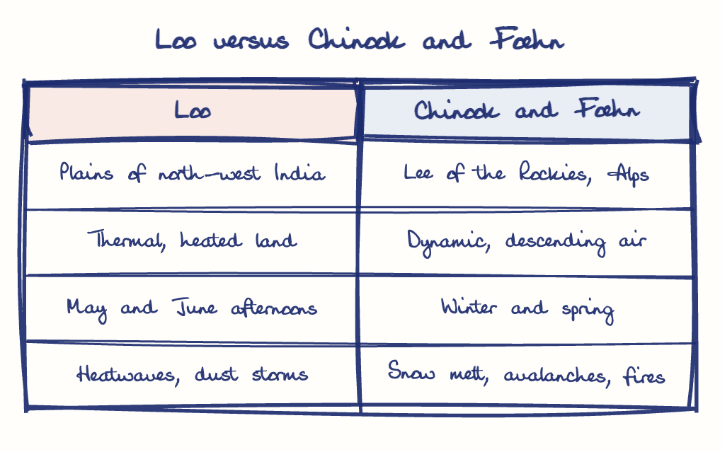
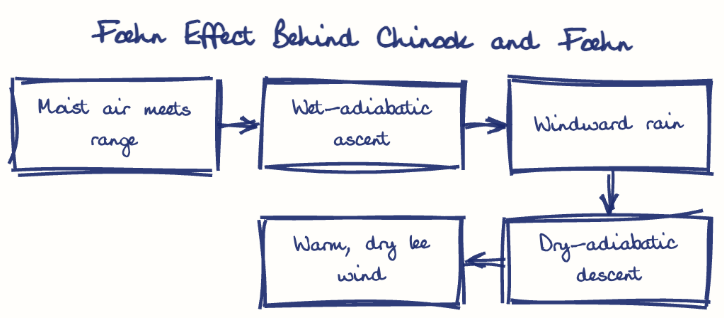
The Loo is a thermal hot wind of the north-west Indian plains in May-June, while the Chinook of the eastern Rockies and the Foehn of the northern Alps are warm, dry downslope winds created by the foehn effect. The Loo brings heatwaves; the other two melt snow rapidly.
Model answer
Ghissu Editorial · Verified 4 Oct 2026 · 294 words
Loo
A hot, dusty westerly blows over the plains of Punjab, Haryana, Rajasthan, Delhi, Uttar Pradesh and Bihar on May-June afternoons, often at 45-50°C, as a thermal wind of an overheated interior.
Chinook
A warm, dry downslope wind descends the eastern Rockies into Alberta, Montana and the Great Plains in winter and early spring.
Foehn
A warm, dry wind descends the northern Alpine valleys of Switzerland, Austria and Bavaria, mostly in spring.
Loo, heat stress
It brings heatwaves, heatstroke and dust storms, with Phalodi touching 51.0°C in 2016, yet it deepens the heat low that draws in the monsoon.
Chinook, sudden thaw
It melts snow within hours, as when Loma, Montana warmed by 57°C in a day in 1972, opening winter pastures.
Foehn, mixed blessing
It ripens Alpine grapes and lengthens the growing season, but triggers avalanches and spreads fires.
Heat Action Plans
Ahmedabad's 2013 model and NDMA guidelines should cover every Loo-hit district.
Targeted warnings
Heatwave alerts in India and avalanche and fire warnings in the Alps and Rockies must track these winds.
This model answer is indicative and the model can make mistakes; please verify key facts independently.
Practise this question
1Get the answer sheet
Sized for this question.
2Write your answer
Timed, by hand.
3Get it marked
Your score and what to fix.
This chapter in the exam
Climate8 questions
Asked in 7 of 14 sittings since 2013
- 2024What are aurora australis and aurora borealis? How are these triggered?
- 2022The troposphere is a very significant atmospheric layer that determines weather processes. How?
All 8 questions, sorted by sub-topic, with model answers and practice.
Question from the official UPSC Civil Services (Main) Examination 2026 paper. Answer written by Ghissu's engine and checked against our editorial standards. Found an error? Tell us and we correct it within 48 hours.