2026 · GS Paper 4 · Q2(a) · 10 marks
An endangered tribe has developed a severe skeletal deformity. A university research has identified a mineral supplement as a possible remedy, though clinical trials are yet to be conducted. Should the District Magistrate (DM) use this research on the tribe? Discuss from the perspective of medical and administrative ethics.
In short
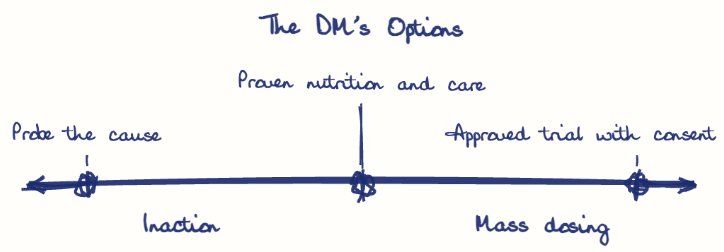
The DM should not order an untested mineral supplement for the tribe, because non-maleficence, informed consent and his limited competence forbid it, but he must not stay passive. Under the New Drugs and Clinical Trials Rules, 2019, the remedy must come through an approved, consented trial while proven care continues.
Model answer
Ghissu Editorial · Verified 4 Oct 2026 · 282 words
Non-maleficence first
Without trials the dose, toxicity and interactions are unknown, and excess minerals can themselves damage bone, so mass use could deepen the harm.
Informed consent
The Nuremberg Code (1947) made voluntary consent absolute, and the ICMR National Ethical Guidelines (2017) demand extra protection and community consultation for vulnerable groups, in their own language.
Justice, not experimentation
The Tuskegee study (1932 to 1972) shows how marginalised people become test subjects; an endangered tribe must not bear risks others would refuse.
Acting within competence
Under the New Drugs and Clinical Trials Rules, 2019, a trial needs ethics committee approval and, where required, CDSCO permission, so a DM's order would be unlawful.
Urgent duty of care
Inaction is also a choice, as an endangered tribe is likely one of India's 75 Particularly Vulnerable Tribal Groups, whose survival the state holds in trust.
Find the cause
Skeletal deformity in parts of India stems from fluoride in water, so testing water, diet and genetics may yield a proven remedy faster.
This model answer is indicative and the model can make mistakes; please verify key facts independently.
Practise this question
1Get the answer sheet
Sized for this question.
2Write your answer
Timed, by hand.
3Get it marked
Your score and what to fix.
This chapter in the exam
Ethical concerns and dilemmas in government and private institutions13 questions
Asked in 7 of 14 sittings since 2013
- 2026Owing to paucity of time, a university professor generates a Ph.D. evaluation report using Artificial Intelligence and submits it with some modifications. Discuss this from the perspective of accountability and integrity.
- 2026A business house is working on a project that could displace a forest community from their habitat. As the administrative officer of that district, what ethical challenges are you likely to face?
All 13 questions, sorted by sub-topic, with model answers and practice.
Question from the official UPSC Civil Services (Main) Examination 2026 paper. Answer written by Ghissu's engine and checked against our editorial standards. Found an error? Tell us and we correct it within 48 hours.