Analyse the factors that contributed for the growth of Magadhan imperialism.
In short
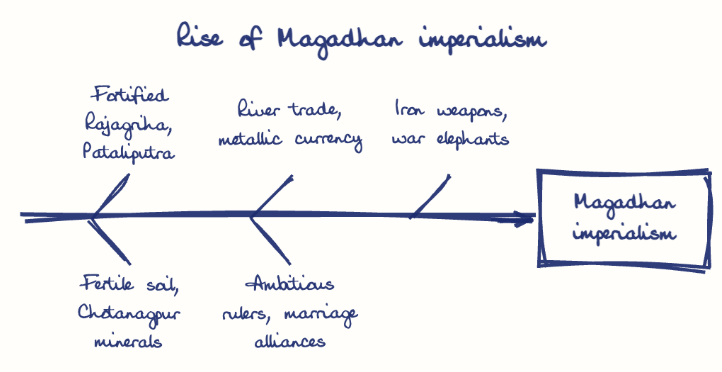
Magadhan imperialism grew from strategic geography, fertile alluvial soil, forests supplying elephants and timber, nearby iron resources, river trade and ambitious rulers backed by a strong army. Kings like Bimbisara, Ajatasatru and Mahapadma Nanda expanded it from fortified Rajagriha and Pataliputra at the Ganga, Son and Gandak confluence.
Model answer
Ghissu Editorial · Verified 4 Oct 2026 · 303 words
Favourable Location
Rajagriha’s natural fortifications and Pataliputra’s river confluence secured trade and defense, controlling key communication routes.
Rich Resources
Fertile alluvial plains, forests for elephants, and mineral-rich Chotanagpur plateau supported economy and military. Access to timber and metals enhanced weapon production and logistics.
Enterprising Rulers
Bimbisara, Ajatasatru, and Mahapadma Nanda expanded territory through conquest and matrimonial alliances, increasing diplomatic influence and consolidating power.
Military Organisation
Iron weaponry and war elephants, backed by efficient resource extraction, enabled subjugation of rivals like Avanti. The hereditary ministerial system ensured stable governance supporting military campaigns.
Rivalry with Avanti
Delayed supremacy showed limits despite advantages, highlighting the competitive political landscape.
Integration of Diverse Regions
Required strong administration and military presence to manage varied populations and prevent rebellions.
Geopolitical Changes
Persian and Macedonian incursions forced strategic adaptations, compelling Magadha to consolidate core territories and extend influence.
Strengthen Administration
Decentralize governance inspired by hereditary ministerial systems to manage diversity effectively.
Leverage Geography
Develop riverine infrastructure to boost trade and integration, emulating Magadha’s use of natural waterways.
Sustainable Resource Use
Protect forests and minerals for long-term economic and strategic strength.
Strategic Alliances
Continue diplomatic engagement reflecting historical matrimonial diplomacy to maintain regional stability.
This model answer is indicative and the model can make mistakes; please verify key facts independently.
Practise this question
1Get the answer sheet
Sized for this question.
2Write your answer
Timed, by hand.
3Get it marked
Your score and what to fix.
This chapter in the exam
Ancient India - Pre-history, IVC, Vedic, Mauryas, Kushans, Satavahanas, Sangam, Guptas16 questions
Asked in 8 of 8 sittings since 2008
Most tested: Harappan civilisation—urban planning, origin/decline, and continuity.
- 2025Discuss the origin and expansion of the Indus Valley Civilization.
- 2025Briefly analyze the teachings of Buddha and Mahavira.
All 16 questions, sorted by sub-topic, with model answers and practice.
Question from the official APPSC Group-I Mains 2008 paper. Answer written by Ghissu's engine and checked against our editorial standards. Found an error? Tell us and we correct it within 48 hours.