Briefly analyze the teachings of Buddha and Mahavira.
In short
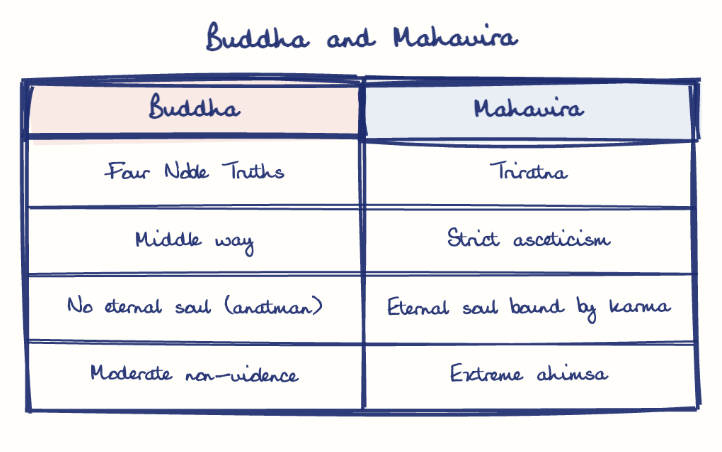
Buddha taught the Four Noble Truths and the Noble Eightfold Path as a middle way to nirvana, denying an eternal soul, while Mahavira taught the Triratna and five vows for freeing an eternal soul from karma through strict ahimsa and asceticism. Both rejected Vedic authority and caste.
Model answer
Ghissu Editorial · Verified 4 Oct 2026 · 311 words
Four Noble Truths1 and Ethical Foundations
Buddha’s Four Noble Truths diagnose suffering and prescribe the Noble Eightfold Path, forming the ethical basis for human action and spiritual liberation. This middle path avoids extremes of indulgence and asceticism, promoting wisdom, ethical conduct, and mental discipline.
Triratna and Five Vows
Mahavira taught right faith, right knowledge and right conduct, with five great vows led by strict ahimsa, to free the soul from karmic bondage.
Rejection of Vedic Authority and Caste
Both denied Vedic infallibility and caste, preached in the people’s languages and founded monastic orders.
Buddhism’s Enduring Influence
Buddhism’s moderate non-violence and compassion enabled its spread across Asia and influenced Indian diplomacy and society, while Jainism’s ahimsa linked it to mercantile urban communities. The Mauryan emperor Ashoka’s patronage exemplifies Buddhism’s historical impact on governance and ethics.
Philosophical Divergences
Buddhism denies an eternal soul (anatman), emphasizing meditation for nirvana; Jainism posits an eternal soul liberated by asceticism, highlighting doctrinal differences. These distinctions shaped their respective soteriologies and practices.
Promoting Ethical Education and Social Welfare
Integrating non-violence and compassion into education and applying Gandhi’s trusteeship concept can foster social harmony and responsible wealth distribution. Encouraging interfaith dialogue and preserving ancient texts will sustain their relevance in modern society.
This model answer is indicative and the model can make mistakes; please verify key facts independently.
Sources
Practise this question
1Get the answer sheet
Sized for this question.
2Write your answer
Timed, by hand.
3Get it marked
Your score and what to fix.
This chapter in the exam
Ancient India - Pre-history, IVC, Vedic, Mauryas, Kushans, Satavahanas, Sangam, Guptas16 questions
Asked in 8 of 8 sittings since 2008
Most tested: Harappan civilisation—urban planning, origin/decline, and continuity.
- 2025Discuss the origin and expansion of the Indus Valley Civilization.
- 2023Examine the survival and continuity of Harappan culture in the present times.
All 16 questions, sorted by sub-topic, with model answers and practice.
Question from the official APPSC Group-I Mains 2025 paper. Answer written by Ghissu's engine and checked against our editorial standards. Found an error? Tell us and we correct it within 48 hours.